|
||||||||||||||||
Click on Blue Links in the left column to jump to that section within this issue. Most blue links are hyperlinked to other sections or URLs. |
||||||||||||||||
|
||||||||||||||||||||
|
Year of Execution We begin our thirteenth year of journalism doing what we do best - chronicling the doings of the good, the bad, and everything in between; and in the process irritating those who rather remain unaccountable for their ugly deeds. Most of the rest of you are unfortunately silent spectators who scroll down the pages of each issue with no apparent interest in taking an active stand. The results are the same: thousands of Christian refugees from Iraq in appalling conditions wandering the streets of Amman and Damascus; profit-motivated arms dealers speaking on your behalf before the congressional representatives of the United States; religious schisms in a magnificent 2000-year Church over the ownership of building properties; hundreds of thousands of dollars squandered on lawyers laughing all the way to the banks in San Jose; and a growing apathy among ALL local civic organizations. How is this for a "State of the Assyrian Nation" address to begin our new volume? Love Zinda! Hate Zinda! But during the most crucial days of our ASSYRIAN existence do not remain indifferent or disinterested. The great torch of Shamash has been passed onto us and it is our privileged responsibility to pass this symbol of our ASSYRIAN identity to the next generation. Every one of us is a small drop in the ocean of ASSYRIANISM - be it a political leader in Iraq, a patriarch in Chicago, or a journalist in Washington. Many have come before us - greater in stature and far notable in deeds. It is because of their bravery, honesty, and determination that we speak of ourselves as Assyrians in Sweden, Australia, Lebanon, Russia, and even Alaska. Our silence will break the weakened link that is barely keeping us chained together. No one can deny the indispensable influence of Zinda Magazine in every aspect of our Assyrian lives. From policy decisions to securing a surge in the sale of an artist's paintings or CDs, the pages of this publication have become a political and marketing tool unlike any other. We at Zinda understand and feel the outcome of our actions. Specifically, we believe that our most worthy responsibility is to be the conduit of diverse opinions - as long as they are the opinions by the Assyrians and for the Assyrians. Respect for opinions of others is the basic foundation of any democratic society, united in a common goal. The undeniable fact of the matter is that in a time of great need for collective action and undivided attention to a singular political leadership, Assyrians are more disunited than ever. There may be a myriad of opinions - however varied - as long as they are processed and utilized for a common goal. We at Zinda recognize that there is no absolute truth to any opinion; therefore, by bringing you many versions of an opinion on a complex issue, we hope we can all come closer to an agreed condition or compromise. Your opinion matters and it must be heard. Zinda Magazine is your forum; express yourself and listen to others. Then, ignore the negative attitude of those who will neither act nor agree. Come together with your neighbors, your church group, your Assyrian friends, and form small "Action Groups". Educate yourself on the politics, opinions, and attitudes of a people that are at the forefront of Iraqi politics. Ask why the Kurdish government is so diligently working to quiet any autonomy talks for the Assyrian people when the U.S. State Department has already begun meeting with the Assyrian leaders on the transition to an autonomous region in north Iraq. Is it because of the historic love between the Assyrian Christians and the Kurdish warlords or the possible forfeiture of a large percentage of the oil revenue from Kirkuk that may not end up in Arbil, rather in Nineveh. Ask yourself why the patriarchs of this nation months before the 90th anniversary of the assassination of an Assyrian patriarch in the hands of a Kurdish chief quickly rushed to decorate a member of the Kurdistan Democratic Party - all within a few weeks - with medals never before placed around the neck of another Assyrian administrator. Ask yourself why reformers are castigated and Baathists are still elevated in our churches and civic organizations. Then ask yourself why there are no young minds in our church yards studying our theology on Sundays and listening to our poets and artists at our clubs on Fridays. Ask yourself why you can't read Assyrian, why you do not know where you came from and how you got here from the streets of Babylon and Edessa. I am often asked the same question: if there is no monetary gain in publishing Zinda, then how do you and your staff from America, Australia, Holland, Sweden, Russia, Iraq, and a dozen other countries continue to do this every week? I give them the same answer every time: We know where we come from and where to we are moving. Having gained this knowledge is the greatest inspiration behind all that we tirelessly do at Zinda Magazine. Zinda has been our "Action Group" for the last 13 years and we hope our finite wisdom, transparent in every issue, will inspire many of our readers to form other similar movements. I began this editorial with a grim view of our condition today. Permit me to pass the burden of explaining the reasons for this dark predicament to someone greater than myself. No words can properly describe the problems of today's Assyrians, on this first day of the Thirteenth Volume of Zinda Magazine, as those of my mentor, William Daniel. He eloquently foretold our perplexing predicament in his book "Assyrians of Today, Their Problem, and A Solution" back in 1969. The following article is as relevant to the challenges we face today as they were some 40 years ago. But first, on behalf of all of us at Zinda Magazine, allow me to thank you all - our avid readers, critics, advertisers, lawsuit filers (against Zinda that is) , senders of hate-mail, senders of flowers, callers praising us, callers shouting obscene words in languages none of us comprehend in Washington, visitors who encourage us with their support and gifts, visitors who never have the courage to meet with us and claim they never found our office in Washington, bishops who call our families threatening us should we publish our views against their policies, bishops who pray for our families as they go through similar trepidations, our wives, husbands and children who continue to love us despite the thank-less life we have afforded them, and the few cronies who enjoy posting opinions and articles on various websites pretending to be the editors and writers of this publication. We thank you all for making Zinda Magazine the indisputable voice of the Assyrian nation. Second, I personally like to thank our Zinda staff in every corner who selflessly spend so many hours writing, editing, collecting information, searching through the Internet, library books and magazines, interviewing the good and the bad, and putting all this into a familiar format that most of you have come to know as Zinda Magazine. Thank you for your dedication and for hanging in there, no matter how tough the going got this past year. Finally, I want to thank one person who has had to bear so much in the last few months - especially these last few weeks - when she and her family were the object of a few cowards' malign intentions. After a call from a bishop of the Assyrian Church of the East to her family's home, my wife could have tried to convince me to stop or at least slow down a little, and publish less controversial editorials. Instead, my beautiful Nina after visiting her family, returned to Washington to convince me that it’s time to put greater effort in publishing Zinda in other languages, so more people will know the facts and rely less on the clowns behind rented microphones, leased cameras, and inside Kurdish-paid studios. What more can a man ask of his life-long partner! To those who thought Zinda has slowed down and is slowly degrading: Zinda is pleased to announce the release of its first major design make-over in several years on the first day of the new Assyrian year. We promise that you will love the new design and our new look and feel. Contact us if you are a web developer and wish to join our current team of advisors. The party doesn’t stop here! On May 1, Zinda will once again be published in the Russian language - as resolved in a recent meeting of the heads of the Assyrian organizations in the city of Krasnodar, Russian Federation. The debut of the first issue will be inaugurated in the city of Urmia, Russia. Russia and the surrounding Republics are home to the second largest Assyrian-speaking community outside of the Middle East. And then on June 22, Zinda Crew will astonish the Assyrian readers and the Syriac-speaking world with the release of the first issue of Zinda Magazine in both English and Assyrian (Syriac). For the first time in the history of the Internet, full Zinda articles can be read in Assyrian (Syriac) - a major step in reviving the importance of the language spoken by Jesus Christ and the modern Assyrians. Who says the Assyrian language is dead? A new ZINDA; published in English, Russian, Assyrian, and later in Arabic. We are determined to make 2007 the Year of Execution, and invite our readers to do the same: Ignore the voices of negation and apathy, and stand up for what is rightfully yours in the Middle East and in the Diaspora. Listen, Speak up, and Act ! And freely express yourself through the pages of Zinda. Thank you for very much for your undying support and for reading Zinda Magazine. Zinda Magazine. Because Assyrians deserve the best. The Weakening Factor William Daniel (1903-1988) Thus far the strongest blow to the [Assyrian] national unity was the religious splits that were born among them and which annihilated whatever unified strength they had left. Now they had nothing, not even a religious unity in favor of which they had abandoned all their earthly glory, military power and the severe discipline, which their forefathers had cultivated to the point of becoming their second nature. The only surviving shadow of orderliness was a thin fiber that was retained from the strong old disciplinary fabric and now was loosely introduced into the texture of ecclesiastic system. In a study of all important nations of the world we cannot fail to observe how much religious owes its growth to the political protection under the sunshine of which it thrives luxuriantly and under the refuge of which it reposes with security. We can imagine the conditions of the Assyrian religious campaigns of which the success depended solely on the virtuous conduct of its members plus the indulgent but unreliable mood of non-Christian powers that dominated them politically. The advent of religious schism afforded abundant cause for internal strife. We might venture to say that the former warlike spirit was reborn and cultivated under a new banner. Now the campaigns were transferred from former military battlefields to the present religious arenas, from former strategic moves against invading armies and revolting nations to quarrels with own brethren because of dogmatic differences in common faith. Yes, the Assyrians had deliberately and imprudently submitted themselves to their last mortal blow. During these times they identified themselves by their religious denominations. Now they chose to be called: -first, the Church of the East; later, Nestorians, then came Jacobites, Maronites, Malakites, etc. The terms Assyria and Babylon were obscenities not to be mentioned, leave alone not to be related to. Those people were heathens for they had made war on God’s chosen people. The differences in dogmatic details of religious doctrine as existed among these different factions, resulted in bitter mutual hatred and violent desire to differentiate themselves from each other so categorically, as to even deny any earlier national relationship. The giant names of Assyria and Babylon sank into depths of oblivion and in their place schismatic appellations shot up like thorny bushes edging each other for self-prominence. Subsequent centuries found these factions drifted so far apart that a national relationship was, not only denied, but actually unknown; neither was any racial affinity recognized among the followers of the different churches. Probably, it would be more correct to say that they were so completely overwhelmed by religious domination that there was no room left for such a profane knowledge as ethnology. Much, much later their descendants would have a tough riddle to unravel. The more the religious fire was fanned, the less consideration was given to material things, which resulted in serious shortages of necessities of life. The descendants of the two of the richest and mightiest empires often fed on misery and drank tears of bitterness. What with rough handling, submission to plunder and pillage, often they were reduced to the lowest dregs of poverty. So it is not surprising to learn what an easy prey they became to the hunters of Western World who filtered into the Middle and Near Eastern lands with their Christian missionary banners unfurled... We paid the price of our ignorance and paid it dearly too, for we lost everything we had: -lives, homes, gardens, cattle and worst of all we lost footing with the powers in whose lands we had been living for centuries. Casualties during [the First World War] were estimated to be about 45% of the then existing population. ...The experience opened our eyes; we learned to differentiate between religious fervor and national zeal. Until then we had identified ourselves by our religious denominations plus a misnomer – SOORAYI – for which our thanks are tendered primarily to Greek historians and late to the foreign missionaries. But now a National identity began to shine like the Morning Star. Now the exhortations of personalities like Freidoun Atooraya, Benjamin Arsanis, Shlemon of Salamas and in the U.S. the fiery speeches of Yoel Warda and the revelatory pen of Yosep Malick began to make sense. Now the seed of Nationalism, whether for good or for bad, had been sown; but it still had to fight for existence among the deep rooted poisonous weeds of religious fanaticism and ignorant strong-headedness...Later the names of Professors Ashur Youssef, Naoum Faik, Dr. A.K. Youssef and last but not least Dr. David B. Perley...were added to the list of torch bearers... But the power and control of the churches over the people stayed as firm as ever. The preacher's authority was not, in the least bit, diminished. Whereas in all the Christian world, preachers and devotees have begun to interpret the scriptures in a more practical manner, a way more compatible with the time; the majority of Assyrians accept the holy book literally instead of symbolically. The preacher's command today, as it was centuries ago, stands supreme. Consequently, in spite of the awakening that caused a mild social upheaval, the power of Church is as firm as ever. One small breath of its representative is enough to deviate the successful sailing of any new social project. To the already existing chaos of religious split one other social one other social confusion had been added – a state of absence of purpose. One more dissolving element had sprung up, for besides churches against one another, now we had added one organization against another, one club or group fighting the other. But all these developments did not, in the least, interfere with the way of the preacher. The more the social chaos the stronger his position became... ...The average Assyrian of today knows everything; he
cannot be taught, for he knows it already. If he sees
that he doesn't, then he loses interest; which
attitude he might either betray by restlessness or he A nation that has no home, no recognized head and
no reliable social system will not be in a position |
|||
What Does an Administrative Area Mean? Understanding the ‘Nineveh Plain Resolution’ Michael Youash
Introduction In 1565, one of the oldest Catholic Military Orders that fought for and held Jerusalem, was driven out of the Holy Land and the Middle East. These Christian warriors retreated to the island of Malta. Jean Parisot de la Valette, their commander, had 541 knights, 5,000 Maltese militia and 500 slaves. The Ottoman Caliph sent close to 40,000 trained soldiers, which included 6,300 Janissaries (the Ottomans’ finest troops). In the build-up to this battle, many Kings and other leaders in Europe kept sending word of support and promises. None of these promises were kept. The knights received no support. Instead, they fought with what they had left. La Valette’s words quoted above came when each man realized they had no one else in the world but one another and their common bond. Their bond was the willingness to live and die for the Holy Land. It was their faith. Today, Assyrians/Chaldeans/Syriacs, face a very similar threat and very similar life-threatening conditions. Almost 2,500 years after the fall of the Assyrian Empire, it appears that our people might finally be driven out of one of our last strongholds. We are succumbing to all forms of targeting, from all sides in Iraq. The knights in Malta were bound to one another through faith alone, however. Assyrians/Chaldeans/Syriacs are bound not only by their faith, but also a blood bond and a history on their lands in Assyria that reaches back at least 6,757 years. They are one people, one nation, and one of them cannot survive without the others at their side. The knights would call one another ‘Brother’, figuratively. We Assyrians/Chaldeans/Syriacs can and do call one another ‘Brother’, literally. That reality can and must make the difference. This article will seek to show readers the situation of a key element of our struggle to survive. That element is the formation of some type of federal unit in Iraq, where we can have some basic assurances of administering our own essential affairs. Where we can safely practice our Christian faith and at the same time help make Iraq a successful democracy. The formation of a federal unit for Assyrians/Chaldeans/Syriacs (herein referred to as Assyrians) and other minorities (Shabaks, Yezidis, Turkmens) is our ‘Malta’. It is our last stand. Without this, there will only be growing refugee flight and an end of the physical connection to the land of our birth as a people. Current Events Before the Constitution of Iraq was released and then approved in a referendum in October of 2005, the Iraq Sustainable Democracy Project (ISDP) put forth a proposal where Assyrians and other minorities should have a province formed in northern Iraq. That proposal developed at a time when certain opportunities were still technically available. Since that time, Assyrians, Turkmens, Shabaks, Yezidis and other minorities are left with a clause in the Constitution that gives them “administrative rights.” This clause carries over from the Transitional Administrative Law (TAL), developed when the US was still formally governing Iraq. Presently this right is put forth in the now famous Art. 125, and says, “This constitution shall guarantee the administrative, political, cultural and educational rights of the various nationalities, such as Turkmen, Chaldeans, Assyrians, and all other constituents, and this shall be regulated by the law.” In terms of an Iraqi federal system, and the territorial aspects of federalism, Art. 125 is understood to equate to the formation of some federal unit that is based on land/territory (jurisdiction) within Iraq. Therefore, for the purposes of this article, which focuses on the territorial elements of this constitutional right, we will hereafter refer to ‘administrative area(s)’ as part of what “administrative rights” allow. The Iraq Sustainable Democracy Project, a policy research body, is working to assist Assyrian political and civil society bodies in Iraq and abroad in working towards this goal of establishing an administrative area through education and analysis. It also works with United States decision-makers and policy institutions advancing this solution to the Christian Assyrian crisis, among others, since its inception. Most recently, this meant being asked to provide language on a congressional resolution supporting in principle the forming of an administrative area for Assyrian/Chaldean/Syriacs. This resolution is provided at the end of this article. It is a concrete step forward. It is a necessary measure at this stage. The resolution affirms in its title that the Nineveh Plain would be a core part of any future administrative area. For this reason, this resolution is popularly known as the “Nineveh Plain Resolution”. What the Constitution Does Not Say This issue is a priority for many in our community. Unfortunately the debate is confusing because the topic is complex, but also because of the wide range of statements by well-meaning politicians and activists. The KDP’s Finance Minister, an Assyrian, is issuing statements on an Assyrian “autonomous region.”[1] The Assyrian Universal Alliance advocates forming an Assyrian Administrative Region connected to the central government. Others are demanding an Assyrian province. The Assyrian Patriotic Party, ChaldoAshur Organization of the Kurdistani Communist Party, Chaldean Democratic Forum, Chaldean Cultural Organization, and the Bet-Nahrain Democratic Party support Nineveh Plain absorption into the KRG and are requesting autonomy in Kurdistan, advocating the exact, ‘administrative rights’, language of Art. 125 for inclusion in the KRG Constitution.[2] The Assyrian Democratic Movement has used ‘administrative unit’ but without further explanation. [3] These are all admirable efforts as they all seek to assist our people in a time of crisis and to help Iraq by ensuring its diversity is not lost. Yet, when one hears demands and appeals for an ‘Autonomous Assyrian Region’ or an ‘Assyrian Province’, a call for an ‘Administrative Area’ naturally seems almost like nothing – why bother even asking for it? It seems like an administrative area is something less. Before discussing whether it is something less, we must first look at options for an ‘Autonomous Assyrian Region’, and ‘Assyrian Province’. For those wanting to establish an ‘Autonomous Assyrian Region’ there is a huge job before you in Iraq. The Constitution is clear on this matter. To establish a region, like the Kurdistan Region, you must get 30 percent of each Governorate Council or 10 percent of registered voters in the governorates you want, to request a referendum to create a region. Then you must win a majority of over 50 percent approving the creation of the region in the referendum. Keep in mind, there is no allowance to take only part of one governorate and part of another to create a region. It is the whole governorate or nothing. Therefore, if it is the governorates of Ninawa and Dohuk that are to become this ‘Autonomous Assyrian Region’, you must convince the huge majority of Kurds in Dohuk and the even greater majority of hostile Sunni Arabs in Ninawa, that their best interests rest in creating the ‘Autonomous Assyrian Region’. The constitution does not say that Assyrians do not have to follow this path to creating an ‘Assyrian Region’. We are not exempt from this standard. The point here is that creating an ‘Autonomous Assyrian Region’ is constitutional, but completely impossible for us politically at this stage. Added to these challenges is that the Constitution recognizes the Kurdistan Region, making its present territory untouchable. Therefore, lands in Dohuk that are Assyrian cannot be connected to lands in Ninawa Governorate, such as the Nineveh Plains. There are those who recognize that we cannot establish an ‘Assyrian Region’ today, and so they are demanding the formation of an ‘Assyrian Province’. If an ‘Assyrian Region’ is impossible, it is at least constitutional/legal. An ‘Assyrian Province’, however, is simply unconstitutional/illegal. There is no language or even a suggestion in the Constitution that a governorate can be split-up to create a new one, and especially to take lands in one governorate (e.g. Ninawa) and another (e.g. Dohuk), to create a new governorate. Those who are promoting this agenda need to be in Iraq and working very hard on the Constitution Amendment Committee. They must either get a seat on the committee, and/or influence the majority of the committee (containing mainly Shi’as and Sunni Kurds) to amend the constitution to allow for the breaking-up of governorates to create new ones and then work to make sure the parliament will adopt the change. This is reality: there is a constitutional way to form an Assyrian Region that is impossible, and no constitutional way to establish an Assyrian Province. What the Constitution Does Say We now return to what the Constitution does say. Art. 125 says, “This constitution shall guarantee the administrative, political, cultural and educational rights of the various nationalities, such as Turkmen, Chaldeans, Assyrians, and all other constituents, and this shall be regulated by the law.” As stated earlier, this is also being equated to allow for territorial rights, which requires an ‘Administrative Area’. The most important point is that at this stage, no one in Iraq knows exactly what ‘administrative rights’ means, and by extension do not know what is an ‘administrative area’. Does it mean something less than a region or province? It is listed as the only clause under Section 5, Chapter 4, “Local Administrations.” But if that is the case, there is also district, sub-district, county, town, and village. If this is what administrative rights and unit means, these are the terms that would be used and there would be no special identification of Assyrians and other “nationalities.”
So What Is An Administrative Area? An ‘administrative area’ is a unique arrangement. It is something exceptional. Most important, it is an opportunity we cannot allow to pass us by. It is not a region or a province, but it is also not a district or a county. It is a chance to develop something that is legal; that we can define, and that we can build on for the future. It is our most practical and realistic step forward and is a tool to help keep ethnic and religious pluralism alive in Iraq – a key ingredient for democracy-building.
Territorially, the ‘Administrative Area’ has at its core, the Nineveh Plain (Deshta d' Nineveh – Map 1). This area includes the lands north, east and south-east of Mosul. It is territorially compact, distinct, with its own geography and history (Map 2). These lands presently exist within the Governorate of Ninawa. This ‘administrative area’ also includes lands in western Dohuk, known as the Lands/Plains of the Cross (Sliwana). Together, this administrative area might constitute what is shown in Map 3.
Due to it being a unique constitutional right, it should be allowed to have lands that sit in the Governorate of Ninawa, and lands in Dohuk of the KRG. Territorially, there would also be an additional allowance for sizable pockets of Assyrians and other minorities in other parts of Iraq to fall under the authority of the Administrative Area. Once again, the unique, protective nature of this federal arrangement, particularly for the indigenous Assyrian Christians should allow for this arrangement. These areas can be determined in future negotiations when forming this Administrative Area. The Administrative Area will have an elected Governing Authority and also an elected legislature. There would also be district and sub-district elected officials to manage purely local affairs, along with town and village mayors and councils. This would be just as is done for any federal unit. The Administrative Area would also be directly linked to the federal government. In this way, the Governing Authority of the Administrative Area would be able to vote on all federalism decisions coming from National, Regional and Governorate negotiations. Most important are the powers of the Administrative Area. It would be responsible for health (pharmacies, primary health care centers, district-level hospitals,); primary, secondary and tertiary education, as well as special cultural, technical and vocational education programs; various judicial matters; economic development planning (rural and urban); social welfare; agriculture; sanitation; local policing; along with special powers regarding archeology and tourism, among others. It would have the power to tax based on its functions and therefore would also have treasury and revenue agencies. Funding for these and other services delivered in the Administrative Area will be received as direct transfers to the Governing Authority. The amount of funds for the identified services will be based on the same system of dividing funds to regions and governorates in Iraq. The Governing Authority and the elected Council will actually determine the use of funds for the services it is responsible for delivering. These are the basic pillars necessary for establishing the Administrative Area. A comment is necessary on the issue of ‘autonomy’. Many people misuse this term. The KRG has a higher degree of autonomy, a governorate has less. Just as there are many shades of the color gray. When someone says, “she was wearing a gray dress”, and, “it looks gray outside”, we know that it is not the same color gray– as if there is only one shade of gray. In this case, the Administrative Area will have autonomy based on the powers listed above. Readers must realize that when someone says, “I am demanding autonomy for Assyrians”, they must ask: “What form of autonomy? Be specific.” Remember, the Constitution does not even refer to ‘autonomy’, or the KRG, as “autonomous.” Many will say that the Constitution of Iraq does not matter. They will say that rule of law does not exist in Iraq and what matters is power (mainly money and guns). This is true. One of the realities for minorities such as Assyrian Christians, Turkmens, Shabaks and Yezidis, is they cannot threaten the use of force if they do not get what they want. They are not a threat to anyone. As a result, their only avenue at this time is to try and use the law and political channels. It is one of the levers, if a weak one, available to them. To simply ignore it and say it means nothing, while promising an autonomous region or a province, means you have enough power to become a threat to other power-brokers in Iraq. If so, our people can reasonably expect the following basics to be in place:
The Kurdistan Region Option Many speak of federalism options available through the Kurdistan Regional Government. This is because the Minister of Finance (former Deputy Prime Minister, before the KDP-PUK merger), the Hon. Mr. Sarkis Aghajan is issuing public statements on demanding autonomy for Assyrians, as part of the Kurdistan Region.[4] Other active political organizations of various sizes operating in northern Iraq are now echoing similar goals. People supporting this position argue that Assyrians need friends in a violent Iraq; the Shi’a Arabs and Sunni Arabs provide no hope, and so we must turn to the Sunni Kurds. Some groups are managing to secure modest amounts of funding from the KRG, which is welcome, but not at levels where sustainable communities are being developed. The question is, although the KRG is most certainly deserving of our gratitude for the little funding it does provide, and the public statements on autonomy are appreciated, is it enough to provide an assurance of a future in the Kurdistan Region? Does it at least guarantee a federal unit where, even if we cannot expect democracy, we can expect a degree of the “autonomy” expected? I will not address here the arguments based around local and regional power (for example, what acceleration of targeting there would be by Sunni Arabs for formally joining the Kurds in ‘breaking-up’ Iraq, or the impact in Syria and Turkey). Instead I will focus on some clear and hard facts to bear in mind regarding this option. This is not a matter of totally rejecting the KRG option. Instead, it is to advise a highly cautious approach, where we secure some basic guarantees. These are listed below. Last week, our people were informed that the Hon. Fawzi Hariri (KDP Minister of Industry in Baghdad), came to Washington, DC. During his official visit, he met with Congresswoman Anna Eshoo. He tried to end any support for developing an ‘administrative area’ on the grounds that Assyrians did not number enough for any type of federal unit and raised questions about their ability to govern such an entity. This act inherently contradicts the statements of the Hon. Sarkis Aghajan. This should cause grave doubt and concern. Such a serious contradiction between two senior ministers of the KRG/KDP must be explained. The KRG must provide the following:
Over-lapping with this issue, but still deserving of treatment, is the matter of the Draft Constitution for the Iraqi Kurdistan Region. Given the statements and demands of KDP Minister Aghajan, and even a quote attributed to the KRG’s Prime Minister, Nechirvan Barzani, supporting Assyrian autonomy, the Kurdistan Region Constitution has a major weakness. In its present form, the KRG Constitution does not even have an equivalent to the Iraqi Constitution’s Art. 125 that gives us administrative rights. The KRG, with senior representatives making promises of autonomy, denies the same type of constitutional right coming out of Baghdad, let alone one that allows for autonomy. The KRG must provide the following:
Lastly, the KDP arm of the KRG directly intervened in the Nineveh Plain to prevent Assyrians and other minorities from voting in the January 2005 elections. Journalist Gareth Porter uncovered this story using military intelligence sources. His investigation led to further reports of denying our people the vote during the October referendum. There are similar reports of gross voting irregularities arising from KDP intervention in the December 2005 elections. Greater attention by US authorities in the December elections ensured more people could vote, however. Assyrians must ask themselves a vital question regarding this fact. If the KDP cannot trust us to vote and pick our leaders; if they cannot trust us to decide whether a draft constitution is good for us or not, can we expect them to trust us to run an autonomous region/province within the Kurdistan Region? I will not make this decision for readers, but I ask that when answering it, one be honest with themselves, at least. The KRG must provide the following:
If these three basic guarantees cannot be met, it is difficult to see how Assyrians should leave all other federalism options to jump into a Kurdistan Region. There are other issues, related to human rights, intimidation, assassinations, strong-arming, arbitrary arrests, illegal land seizures, de-development of targeted areas, among others – all verified by external human rights bodies. However, the issues above alone cast enough doubt without having to go into even more problems with KRG authorities. Conclusion The hope of this article is mainly educational. It is to make the average, interested Assyrian/Chaldean/Syriac individual aware of what is developing. It is also meant to equip them with the knowledge to judge for themselves what people are promising and what is the most practical way forward. ISDP believes in its researched positions, and stands by the content of the proposed resolution, as a small but necessary step forward. There is further evidence that the organizations pursuing this resolution are on the right track and deserving of support. The KDP never took action regarding other efforts, where Assyrians made declarations for an Assyrian Autonomous Region. They lifted no finger while persons stated that the formation of an Assyrian Province was imminent. The KDP did react when suddenly facing the realistic and productive policy approach put forth in the “Nineveh Plain Resolution.” When asked on what he felt about the Nineveh Plain Resolution, the KDP Minister Fawzi Hariri felt the need to undermine any effort for establishing a federal unit for Assyrians because he saw the threat of a realistic policy for the first time. The noble aspirations for autonomous regions and provinces are exactly what our enemies want us to adopt, simply because they dazzle us with their brilliance and appeal to our imagination, but will not bear fruit. The KDP and others want us to be distracted with these “false hopes” while real opportunities pass our people by. Our people now need to see political parties pursuing the realistic vision described here and developing in the homeland – with reasonable information sharing on progress. For those wondering about the fate of the knights mentioned at the start of this article, they defeated their Ottoman enemies. They overcame all odds and beat back a massively superior force. The knights in Malta put aside all false hopes and accepted the reality of their options. The knights did this with faith alone. Our People’s faith, prayers and our brotherly unity as Assyrians/Chaldeans/Syriacs will also produce success – but we must let go of the “false hopes”, and pursue the difficult path that is grounded in a realistic understanding of our options at this point in time.
‘NINEVEH PLAIN RESOLUTION’
------------------------------------------------------------------
Notes:
|
||||||
Assyrian Official of Iraqi Airways Gunned Down Courtesy of Mr. Philimon Darmo and the Assyrian International News Agency Mr Isaac Esho Alhelani was stopped whilst driving with his wife, forced out of the car and shot twice before the assassins fled with his car. According to his children living in Australia, he was then taken to a hospital in Baghdad, but the hospital did not have the resources or medication to treat his serious wounds. He was then flown by helicopter to the city of Arbil where he died. His body was later taken by car to the city of Kirkuk, the place of his birth, for burial by his wife and sister. Isaac was a graduate from an aircraft engineering school in Scotland in the early 1960's where he studied under a scholarship from the Iraqi Government. Upon his return to Iraq after completing his studies with distinction, he was appointed as an aircraft engineer in the Iraqi Airways and climbed the ladder of promotion until he reached the position of Deputy Director. Isaac, who was 64, retired in December 2006. He leaves his second wife in Iraq and four children from his first marriage. Three of the children, his daughter and two sons live in Australia, and his youngest son is in Syria where he escaped to from Baghdad after being threatened with kidnapping. Ordination of 3 Chaldean Deacons in Iraq Courtesy of the AsiaNews
(ZNDA: Ankawa) “A sign of hope amid so much violence and despair”. This is how Mgr Louis Sako, Chaldean Archbishop of Kirkuk, described the ordination of three new deacons that took place on 2 February in Ankawa in Kurdistan. The ceremony took place in the Church of St Joseph and was celebrated by the bishop of Amadhyia and Erbil, Mgr Rabban al Qas. Also present were Mgr Mikha Maqdassi, bishop of Al Qosh, and Mgr Sako himself who as lecturer at the local faculty of theology wanted to express his “support” for the seminarians. Courses offered by the Chaldean Major Seminary of St Peter and Babel College, the only Christian theological faculty in Iraq, resumed officially last month in Ankawa, after the forced relocation of both institutions from Baghdad, which had become too dangerous. The ordained deacons are Salar Soulayman Bodagh of the diocese of Al Qosh, Raymond Hamid Sargis of Baghdad and Louya' Gilyana Dinkha from Mosul. Already last month, on 27 January, Wassim Sabih Youssif was ordained in Baghdad. In the coming days, four Syro-Catholic deacons will be ordained: Raid Adil Fatohi and Mazin Isho' Mattoccha in Mosul on 9 February; Ammar Abdullahad Ayub and Nuhad Sabih Alcas Moussa on 16 February. Speaking about the new ordinations, Mgr Sako described them as “real signs of hope amid so much violence.” And he talked about the latest threats to the Christian community and the umpteenth kidnapping. “A Catholic from Karaqosh, Abdul Khaliq Bakos, the brother of a Dominican Sister, was kidnapped a few days ago in Baghdad; an hour after the kidnapping, his relatives paid the ransom demanded only to find him dead two days later.” The man had three children. The bishop continued: “In Kirkuk, some Christian doctors left the city after receiving a letter asking for an enormous sum of money to be delivered on pain of death.” Mgr Sako said the insecurity that threatened the daily life of all Iraq’s communities had created “a real vacuum at pastoral level” in the church. Meanwhile evangelical groups that arrived with the American army are multiplying. The bishop said: “They are conducting aggressive proselytism even among Catholics and Orthodox and they already have 36 new churches in Baghdad alone."
|
|||||||
Three Assyrians Family Members Murdered in Chicago's Hammer Killing Courtesy of the Chicago Tribune (ZNDA: Chicago) A Chicago's West Rogers Park family had gathered with friends earlier this weekend in a small apartment, sipping warm tea on a cold night. By Saturday morning, three members of the family were dead, bludgeoned with a hammer in what police and others said was an outburst of domestic violence. The suspect is a 56-year-old Iranian immigrant and the husband of one of the victims, Chicago police said. He was hospitalized in fair condition with self-inflicted wounds after officers found him trying to take his own life with the hammer used in the attacks, police said. He had not been charged as of late Saturday.The other victims were the suspect's sister-in-law, who had helped bring him to this country about three months ago, and his 60-year-old mother-in-law, police said.
The suspect and two of the victims were found in a second-floor apartment in the 6400 block of North Washtenaw Avenue, police said. The body of the mother-in-law was in an apartment in an adjacent building in the 2600 block of West Arthur Avenue. Rafi Babayan, a family friend who attended a Friday evening gathering inside the West Arthur apartment, said the victims and the suspect are Assyrians, an ethnic group of Christians largely from Iraq, Iran, Turkey and Syria. He said he used to live near the family in Iran, just as he does in Chicago. "There were no problems," he said. But the gruesome blood-splattered scene officers discovered when they arrived about 7:30 a.m. told a different tale. "I saw them wheeling a man out," said a neighbor, who asked not to be identified. "He was all bloody. His feet were exposed and they were all bloody and he was moaning." The neighbor said he overheard authorities recounting what they saw and heard when they first arrived at the apartment on North Washtenaw. "When they went in, he was hitting himself with a hammer," the neighbor said. "And he said, `I'm almost finished.'" Authorities had not identified the suspect or the victims. But friends and a former husband of one identified two of the dead as Karolin Khooshabeh, 40, and her sister, Karmin Khooshabeh, 44, the wife of the suspect. Police said all three women died of blunt-force trauma. Karolin Khooshabeh's ex-husband, Robert Estepaniance, said the suspect and his wife were having marital problems. He said he received a call Saturday morning from his son, Michael, informing him of the killings. "It's hard to believe it," he said. And now Karolin Khooshabeh will not be there when her son completes high school this spring, Estepaniance said, in tears outside Belmont Area detective headquarters. "She won't get to see Michael graduate," he said. Chicago's Assyrian community, estimated at about 100,000, is one of the largest in the U.S. Its presence is strongly felt in this neighborhood, where Middle Eastern accents, restaurants and shops dominate the surroundings. Estepaniance said he and Karolin Khooshabeh, then his wife, feared that as Christians they would be oppressed in Iran and left in 1995. They settled in Chicago a short time later. He said his wife's parents arrived in the city about four years ago. Karmin Khooshabeh and her husband moved into the four-story brick apartment on North Washtenaw in November, said a maintenance worker who asked not to be identified. They were nice people," he said. "Very nice people."Police said the adult son of the sister-in-law was in the apartment but asleep when his mother was killed. "According to his statement, he was unaware of what had transpired," said police spokeswoman Monique Bond. "At this time, it doesn't appear that there were any other witnesses in the units where the homicides occurred."Babayan, the family friend, said the suspect's teenage daughter also was away at the time of the attacks, staying at another relative's home. He said the suspect's father-in-law was hospitalized and not home. Bond said language barriers slowed the investigation Saturday as law-enforcement officials struggled to locate interpreters. Karolin Khooshabeh worked in the meat department at a Dominick's grocery store in Lincolnwood. Dallas Killman, the store's manager, called her a "wonderful employee" but declined to answer any additional questions about her employment or life. Co-workers were stunned to hear of her death. "She was truly loved by all of us here," a co-worker said. "She just had a heart of gold. She always listened and she was always kind." Congress of Assyrians of Russia Support 'Nineveh Plain Resolution' For Immediate Release On 3-4 February, 2007 the Congress of the Assyrians of Russia took place in Krasnodar, Russian Federation. Leaders of the Assyrian organizations from Krasnodar, Moscow, St. Petersburg, Kaliningrad, Kazan (Tatarstan), Rostov-na-Donu, the village of Urmia (situated in Krasnodar territory and the most densely populated Assyrian area), Maikop as well as Armenia, Georgia, Ukraine, Belorus and Kazakhstan participated in the meetings. The representatives of the administration of Krasnodar and Krasnodar territory were cordially invited to participate in the Congress as honorable guests. The following issues were discussed at these meetings during the two days of the Congress: 1. The question of uniting the Assyrian organizations in the Russian Federation. In the light of the latter issue a decision was made to send official letters to the President of the United States, members of the the U.S. Congress, and the State Department with the following message:
The leaders and representatives of the Assyrian organizations of the Russian Federation also made a decision to establish an umbrella organization to represent the Assyrian national and cultural organizations of the Russian Federation. Assyrian Universal Alliance Reacts to Recent Allegations For Immediate Release Executive Committee Recently, Mr. Praidon Darmoo, Deputy Secretary-General of the Assyrian Universal Alliance (AUA), visited Washington, DC as a member of an Iraqi delegation headed by Mr. Fawzi Hariri, Iraqi Minister of Industry. The purpose was to meet members of different committees in both the Senate and House of Representatives to gain support for Iraqi industrial plans. In addition, the delegation also met with several American companies to encourage them to invest in Iraq. It was also a great opportunity for Mr. Darmoo and Assyrian-Iraqi Minister Hariri to meet with Assyrian-American Congresswoman Anna Eshoo. No agenda was set as it was a genuine courtesy meeting between two high-ranking Assyrian politicians. The proposed Nineveh Plains resolution submitted by the Iraq Sustainable Democracy Project (ISDP) to Congresswoman Anna Eshoo was unknown to Mr. Praidon Darmoo prior to their meeting and was evidently unaware of such resolution. AUA believed it had made it clear through its resolutions and struggle that it will not object to any project that will serve Assyrian interests and future in Iraq. Most particularly, AUA supports an Assyrian federal unit within the framework of the Republic of Iraq, as declared in its declaration of the 24th congress held in London, England on July 7 – 9, 2005. On January 20, 2007, three days following Mr. Darmoo’s meeting with Congresswoman Anna Eshoo, this position was once again made clear to Mr. Michael Youash, Project Director of the Assyrian Academic Society Iraq Sustainable Democracy Project, during a telephone conversation with Dr. Emanuel Kamber, Secretary-General of the AUA. Dr. Kamber reiterated that the AUA rejects any national name for the Assyrian people other than “Assyrian” and disagrees with the border of the proposed administrative unit. During an official visit of the AUA delegation to Iraq in 1973, the AUA was the first Assyrian organisation to officially request from the government of Iraq that Assyrians be granted an autonomous status on the land of their ancestors, located between the Greater Zab and Tigris rivers, under the jurisdiction of the central government of Iraq. Today, it is vicious and disrespectful to all those concerned to suggest that Mr. Darmoo and Minister Hariri influenced Congresswoman Anna Eshoo’s decision not to pursue the resolution at this time, as has been rumoured. Mr. Darmoo was not representing the AUA in any of these meetings. This recent propaganda against the AUA and its Deputy Secretary-General only demonstrates why we Assyrians are failing to present a collective submission on behalf of our Assyrian people in Iraq. At a time when Assyrians are desperately searching for help to secure their future within a democratic, pluralistic, secular, and sovereign Iraq constituted of principles of democracy, rule of law, and guaranteed human rights, and equality for all citizens irrespective of their ethnic or religious background, some are desperately looking for excuses for their failed policy and tactics in gaining our rights in Iraq. AUA will not remain silent on such acts in the future. The AUA will take all necessary actions to expose these malicious and vicarious attacks while defending the interest of our people and the AUA. In conclusion, the AUA will visit Congresswoman Anna Eshoo to make it clear to her and her staff all issues related to the visit of Mr. Darmoo. We hope she will take all the necessary steps to prevent such distortions in her future meetings with dignitaries and to clarify our position on issues related to the future of our Assyrian people in Iraq. May God help our Assyrian people in Iraq and worldwide.
Iraqi Embassy in Sweden Forges False Passports Courtesy of the Daily Mail (ZNDA: Sweden) The Iraqi Embassy in Stockholm has issued thousands of passports with false information to asylum seekers, helping them gain residency in Sweden or Norway under fake identities, immigration officials have revealed. The embassy, which serves both Sweden and Norway, has 'nearly non-existent' controls of the identification papers Iraqis present when applying for a passport, said Bengt Hellstrom, an expert with the Swedish Migration Board.
Iraqi Ambassador Ahmad Bamarni strongly denied the allegations, saying embassy staff conduct rigorous background checks on all passport applicants. "Absolutely none of our passports have been issued on false information," Bamarni said at a news conference in Stockholm. "We would never deliver a passport if we have doubts about it." The Foreign Ministry summoned Bamarni to discuss the issue. The Scandinavian country has emerged as the most popular destination in Europe for Iraqis fleeing the war in their homeland, in part because of its relatively lax immigration laws. Nearly 9,000 Iraqi asylum seekers arrived in Sweden last year, triple the number for 2005, according to Migration Board statistics. Once in Sweden, many asylum seekers apply for official passports issued by the Iraqi Embassy in Stockholm based on wrongful information on their fake ID documents, immigration officials said. Hellstrom said some sell the passports for thousands of dollars to other Iraqis wanting to enter Europe. Citizens of other Middle Eastern countries may also want an Iraqi passport because it makes it easier to get asylum in Sweden, he said. The result: Thousands of Iraqis and other foreigners are believed to be living in Scandinavia under false identities, making it nearly impossible to screen for known criminals. "We have seen that (the embassy) regularly issues passports based on documents that we have rejected or deemed to be false," said Hellstrom. "Our faith in these passports is nearly zero. But if we can't say for sure that the papers are false, they will likely form the basis of their asylum application. In the end, that can lead to citizenship." In 2006, nearly 300 passports and other ID papers based on false information were received by the Migration Board's central control agency, Hellstrom said. But the true number was likely in the thousands, because immigration officials only send in a fraction of suspected documents for verification, he added. The false passports became a political issue after a Norwegian man was convicted last year of forging hundreds of ID papers for Iraqis. "If this is true, the government takes it very seriously," said Anders Friberg, a spokesman for the Migration Ministry. "But it's too early to speculate on what measures we might take." In a recent interview with Norwegian newspaper Aftenposten, Bamarni, the Iraqi ambassador, was quoted as saying a majority of passports issued by the embassy were based on false information. On Wednesday, however, Bamarni said he had been misquoted. He said thousands of Iraqis changed their names to escape persecution during Saddam Hussein's regime, and may sometimes use their old names when talking to the Migration Board, while their new name is on their passport. But Hellstrom said there were indications fake passports were being sent from Sweden to Iraq to help others enter the Scandinavian country. According to the Assyrian journalist in Sweden, Nuri Kino, Kurds from Turkey, Syria and Iran have received such fake Iraqi passports issued in Stockholm. They are in turn traveling to the oil-rich town of Kirkuk in northern Iraq to alter the demography in favor of the Kurds, who claim the city as a future Kurdish capitol. Iraq's Foreign Minister, Hoshyar Zebari, also a Kurd, is to visit Sweden in the near future. Swedish National TV Broadcast Assyrian Seminar on Turkey By Afram Barryakoub reporting from Sweden (ZNDA: Stockholm) On Monday, 5 February Swedish national television broadcast a seminar organized by the Assyrian Federation of Sweden, in cooperation with the Swedish Committee for the Support of Human Rights in Turkey and the Assyrian women and Youth federations. The seminar itself took place in the Swedish parliament on the 31 January with 16 MP’s, several journalists and other prominent persons attending the event.
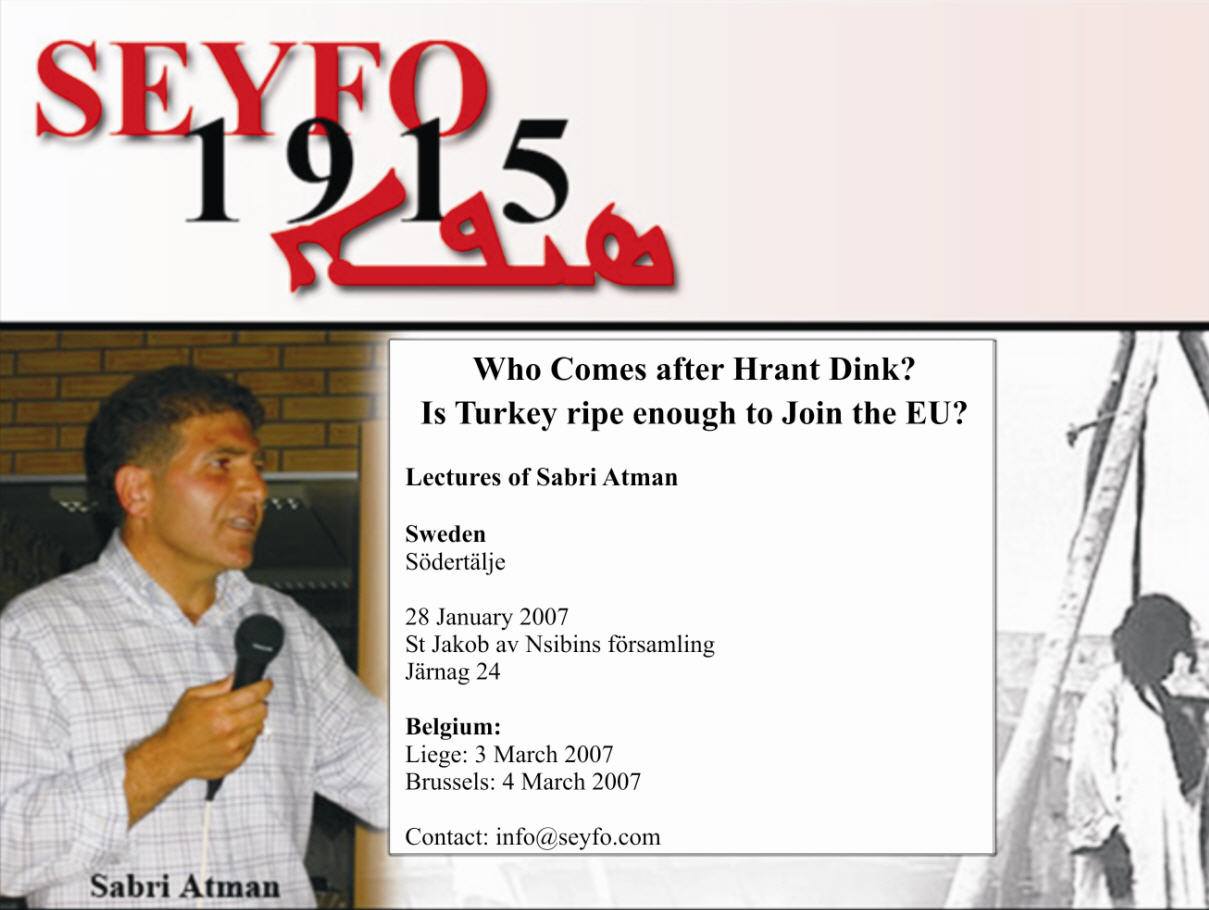
The well attended seminar touched upon today’s situation on the human rights in Turkey, its EU membership candidacy and the Assyrian Genocide, Seyfo. The event was a boost for the recognition of Seyfo as Sweden’s top expert on international law, Prof. Ove Bring said during his speech that the historians have now done their job and it is now time for the politicians to recognize that the Assyrians really suffered a genocide during World War I. Other prominent speakers included the leader for the Left party, Prof. David Gaunt and a former spokesman of parliament. Assyrian writer, Sabri Atman and Turkish publicist Rageb Zaroklu also contributed to the seminar. Both face death threats and intimidations continuously by Turkish nationalists for their work on the genocide. The seminar succeeded in highlighting the situation for minorities in Turkey and the genocide issue among the public and the politicians. It also caught the attention of the Turkish embassy in Sweden as they sent a person to supervise what was being discussed during the seminar. Many observers now draw the conclusion that a Seyfo recognition is within reach for the Assyrian community in Sweden which started to tackle the question on a political level in 1999. Several parliamentary bills are now prepared anew by various MP’s calling for Sweden's acknowledgment of the Assyrian genocide in 1915, in which Turks and Kurds cooperated to wipe out the indigenous Assyrian population from Assyria, now occupied by Turks, Kurds, Iranians and Arabs.
Author of the Armageddon Project on Assyrian Autonomy By Afram Barryakoub reporting from Sweden
(ZNDA: Stockholm) The novel “The Armageddon Project”, mentioned in the previous issue of Zindamagazine, draws upon the current war in Iraq and the policies pursued by the U.S administration. In the novel, a super secret plan is launched by the U.S. president, Christian organisations and Assyrian leaders. Journalist Sam Preston, the main character, is first reluctant to follow up the tip he receives about the secret plan, but finds himself soon entangled in the scoop of the century, a scoop in which Assyrians are a main ingredient. That is also why the “Armageddon project” is more likely to tickle the feelings of the Assyrian reader more than others. Journalistic background combined with fingertip feeling guided American journalist and author Tom Sancton's imagination to come up with the plot of the novel. His research on Iraq leads him to discover the situation of the Christian Assyrians as he surfs the waves of cyberspace in search of information. In his mind grew slowly a complete story with political scandals, secret plans and the idea of an Assyrian state in the Middle East. "I learned that there was a nationalistic movement within the Assyrian community that called for the creation of an Assyrian autonomous region. It seemed to me that, of all the different competing sectarian factions in Iraq, the one that would logically attract the sympathies of a Christian U.S president and his evangelical supporters would be the Iraqi Christians", says author Tom Sancton to hujada.com. The novel's main character, Sam Preston, is tipped by a friend on a huge disclosure which he at first dismisses as nonsense. But his critical attitude changes soon, as events take a new turn. The pursuit for more evidence puts Preston in a dangerous situation as he finds himself on the run from deadly Mossad agents across Europe. The information he has got hold of is sensitive enough to destroy the careers of several leaders and decide the future of the plans for an Assyrian state in the Middle East. The novel can be seen as a topical comment to the war in Iraq and all events related to it as the story reflects the writer's own indignation of the current situation. Tom Sancton admits that he felt increasingly angry about the U.S administrations handling of the situation in Iraq, as he was writing the book and chose to let his feelings pass on to the main character. "As Sam becomes increasingly aware of what is going on, his indignation transforms him from being simply an investigative journalist following a scoop into a moral voice intent on denouncing the high crimes and misdemeanors of the lightly fictionalized president and his inner circle", he reveals. As for the Assyrians of real life Tom Sancton believes that they, as an oppressed minority, are deserving of sympathy and support. He also believes that Assyrian autonomy can only come about in the context of a legal or de facto division of Iraq into a federation of ethnic-religious regions. "I’m not sure that’s the best solution for Iraq, but it's one option if the country’s warring factions are not able to forge a government of national unity in which all groups are respectful of one another. As a practical matter, I think it would be very difficult for a small minority like the Assyrians to assert their autonomy unless the other groups are willing to accept it." But in the world of novels everything is possible and The Armageddon Project is no exception. The story is kept on the borderline between reality and imagination, sometimes following the development in the real world very closely. But the writer could however not restrain himself from using the freedom of imagination to manifest his feelings towards the man running the show in Washington. "Since a writer of fiction can make things happen the way he wants, and not necessarily the way they are in reality, I had the luxury of imagining a just retribution for this mediocre, self-righteous and incompetent president", says Tom Sancton. Violent Attacks at Ishtar Cafe in Hamilton, Canada Courtesy of the Hamilton Spectator
(ZNDA: Toronto) The men who shot a Mountain club manager and beat two customers over the head with a baseball bat described themselves as mobsters, say police. Investigators have charged two men in last week's attack and attempted extortion at the Ishtar Cafe, an Assyrian and Kurdish club on Concession Street. They are seeking a third man. Police say the gang had been pushing the club to use its illegal gaming machines since November. The attack occurred after the owner refused. Police are now hunting Ioannis (John) Chrisanthopoulos, 47, a violent Hamilton career criminal known as Johnny The Greek, who spent time in prison for kidnapping, assault, extortion and uttering death threats. Thursday's arrests come nine days after the masked group shot a 41-year-old manager of the Ishtar Cafe twice in the stomach and beat him. The man remains in serious condition. "As part of their extortion, they made insinuations they are part of Italian organized crime in Hamilton," said major crimes Detective Sergeant Ian Matthews yesterday. "The entire Assyrian and Kurdish community have taken this as a personal attack on their private club where they socialize ... and they have gone out of their way to assist us," he said. "The victims have absolutely no connection to organized crime." The club's operator was singled out to enforce the extortion, Matthews said. Illegal gaming machines are a favourite of organized crime because they force the private club or tavern to take all the risk in the event of a police raid. Johnny (Pops) Papalia, one of the most powerful crime bosses in Hamilton history, was heavily involved in illegal gaming, said Antonio Nicaso, a prominent expert on Italian organized crime. But since Papalia was murdered on a Hamilton street in 1997, Nicaso said, organized crime in town has diversified. "Now there is a tendency in Hamilton for people to pull together in a no-name brand of organized crime," he said. Nikolaos Badounas, 47, and Christo Chrisanthopoulos, 44, both of Hamilton, have been charged with extortion.
|
|||||||||||||||||||
|
To My Nephew, Frank S. Khosho Francis K. Khosho
Again, with unexpected suddenness and deep sadness, death has come among us. It was just three weeks after the murder of his cousin, Basam Polis Kalo Khosho, who was killed in his work place in Phoenix, AZ at the age of thirty-six. Frank had his life taken away from him on January 21, 2007 at the very young age of twenty-three. He has been taken away from us and obliged to move through the Celestial Gate to enter that bourn from which no traveler returns. We can only bow our head to the will of God and His Son Jesus Christ, the Father of us all, and say to ourselves: Is there beyond the silent night an endless day?
Is death a door that leads to light? In his passing, it is difficult to put my feelings into words, but I will try to tell you what my nephew Frank meant to me. Frank was the youngest son of my brother Slewo Kalo Khosho of the town of Mangeshi. Frank was incredibly kind; he had such a beautiful nature about him that endeared him to all who crossed his path. I will never forget his infectious smile, his beautiful brown eyes, his sense of humor, his charm, and most importantly his innocence, sincerity and kind words that touched our family in more ways then anyone will ever know. His parting creates a void that will never be filled and he will forever be remembered by our family. I like to think that Frank is with us in spirit, lives in our minds and will endure in our hearts for eternity. Frank was such a loveable soul; we, his father, mother, brother, sisters, cousins, relatives, friends and Chaldean/Assyrian community of Phoenix, Arizona, who admired him and loved him so much, simplify his ceremony in an expression that has never left my mind. It speaks volumes: “ You never lose what you love if you love what you lose.” May God bless you and keep you. We miss you and love you Frankie, and we always will. Your Uncle A Betrayal of Trust Shmouel Warda I joined the Assyrian Universal Alliance in 1968 under the first Secretary General, the late Dimitri Petros Eloff who accepted my membership, and became the first member of the AUA in Australia, and am very proud of all those founders of this once very effective organization. It was no doubt the most awakening organisation in its nationalistic spirit for a sleeping nation which had no political leadership for over 2000 years. In my 30 years as a member of the Assyrian Universal Alliance I met and worked with many great individuals from our nation, Assyrians, Suryanees and Chaldeans nationalists all over the world, and am also very proud to say that I was elected eighteen years later as the Secretary General of the organization which took place in Sweden. During my long membership I also took part in creating, establishing and presenting the Assyrian flag to the Nation. In 1998 I retired and at present I don’t hold any position in AUA or any other political party, but I am proud to say that I am a staunch supporter of our only serious party, the Assyrian Democratic Movement or Zowaa, with its strong leadership and our only hope. The AUA was the only Assyrian international organization and the umbrella that could drive the hope of our Nation by creating political parties to unite us and get our political rights in the land of our forefathers, Bet Nahrain, at present Garbia (north) of Iraq. Unfortunately now it has been vigorously trying to split our nation in cooperation with the Assyrian Church of the East ’s leadership in arrogantly calling for the Assyrian name only and forgetting about our brothers and sisters from the Suryanees and Chaldeans, thus trying to split our nation. On the contrary the great leadership of Zowaa realised our nation's weakness, and in their famous 2003 conference in Baghdad adopted the three names for one nation and it was unanimously accepted that of the ChaldoAssyrianSuryanee name to face the challenges ahead, and in demanding the Nineveh Plains and once for all to free our nation from the clutches of our church leaders and our enemies who have been trying to split us.
Most of the cofounders of AUA were trustworthy people and held the aims of the organization and so it carried on that loyal trust to fulfil the aims of our nation at any cost. It grew up in the mind of so many thousands of our people all over the globe. The leadership took that oath, and reminded all their members not to miss use the trust of our nation for their own selfish personal gains. The main objective of AUA was to support at any cost our people in Iraq in fulfillment of the objectives of the founders of the organization to take a stand with our brothers and sisters in Iraq especially in times of need and with their political struggle which happens to be right now. The present leadership of the AUA should be ashamed of their present stand in openly supporting the stooges of the KDP and opposing the leadership of the only Assyrian nationalist party on the ground in Bet Nahrain which have given quite a few Martyrs. The only Assyrian party that was twice democratically elected with a staggering 80% of the votes. Since no member of the present leadership of AUA in Diaspora will ever think of selling his house and moving to Iraq. Then who gives them the right along with these newly invented parties that were created after the liberation of Iraq in 2003, in dictating and contradicting our national demands in Washington and elsewhere, and also in criticising our respected and Hon. Congresswoman Anna Esho, because most of those half a dozen numbered parties were working FOR the Baath’s or the KDP parties. Yes, Zowaa too was proudly working WITH the KDP in opposing the brutal regime of the dictator Saddam. So please do not mislead our nation with the standing of Zowaa in the last quarter of a centaury. Try to differentiate between the two words FOR & WITH. Any political party should work at times with other parties to gain their rights and its rights from a brutal dictatorship, but never FOR, like our present puppets in Iraq and particularly the open relationship between the AUA’s leadership along with the Assyrian Church of the East ’s leadership with the KDP to tie up the 'Dishted Nineveh' to the KRG region instead of the Central government of Iraq, Any decent person in Diaspora should support ADM morally and financially and respect the will of our people in the homeland and our unanimously elected party. AUA’s political stand and its position of today is a clear betrayal of that trust. Today they are standing against the Assyrian, Chaldean, and the Suryanees people in Iraq and around the world and undermining the only democratically elected Assyrian leader and a member of Iraqi Parliament Hon. Yonadam Kanna. The wish of our nation has been totally ignored by the present leadership of the AUA. My only concern for the time being is about AUA, because I spent over 30 years of the best part of my young life in a political struggle to reach to this great day of our people in Iraq and yet I see a clear betrayal of the trust that we all worked for and stood for many years. I kindly request the Secretary General’s office to reconsider the AUA political position concerning the will of our people in Iraq and to stand united with our only real political struggle in Iraq under the leadership of our ADM, stand with a brave face and give what ever they need in Iraq. The political role of all those who are not in Iraq is limited and will finally end because the political reality is in Iraq, those who are on the ground under fire are the real Heroes of our times and not we who chose to live in the comfort of the west, we did what we could when our people were living under the dictatorship of Saddam in Iraq. Remember the future of a nation depends to those who live in the fatherland with out them there is no home land and all our dreams will die. A Homeless Nation Sargon B Yalda Last week, on my way to work on a wintry Chicago dawn, where people can literally see their own breath, I noticed a Homeless man that has made it a habit to wake with the early morning commuters in the Windy City and beg. Normally this man does not draw my attention, but since I had just read the Zinda magazine article “Ripped Apart, Patched together” it dawned on me that if we were to asses our situation as a nation, we are very much in the same boat as he; A Homeless Nation. Contrasting Mariam S. Shimoun, I want to take into account the Big Picture before focusing on the details, as it is the natural order. Ask anyone with an idea, a proposal or a scheme and they will tell you; once we have a clear plan of our direction and destiny, then we can start working out the details.
Meanwhile, a more proper analogy would be versus the Copts of Egypt. Today there are over 10 Million Copts in the World (five times the estimated Assyrian population), all of whom are Coptic Orthodox, under the headship of HH Pope Shenouda of Alexandria. You will hardly find Copts that are non Coptic; the Church services are conducted in the ancient Coptic language. Copts politics are integral with their country’s politics, and they have produced some great politicians, among which Boutros Boutros Ghali (Former Secretary General of the United Nations). You will never hear of renegade bishops in their community, nor will you hear constant false accusations against their Church leadership to justify incompetence. Ms. Shimoun continues “rather than relinquish authority to the political parties that can do these things – they are trying to “transfer” authority to the Kurds, who keep them as the overseers, the representatives, of the Assyrian people”. This is another classic misinterpretation of intention, in fact here is where the Pope analogy would have been more appropriate; Pope Benedict’s visit to Turkey last October, do you suppose that there was a hidden agenda there? Or was it merely a head of a Church visiting his flock? We should learn to stop complicating matter needlessly. HH Mar Dinkha’s visit to Northern Iraq was well over due, and for the hundreds of thousands of his flock it was a dream come true. Until today, I still remember Mar Shimoun’s visit to Iraq in the early Seventies, and I know first hand the effect such a trip will have on people back home. It serves to strengthen their faith and to bolster their alliance, and nothing more. I am pleased to see that ZOWAA leadership is attempting to distant themselves from Church politics generally and ex-bishop Bawai specifically. I do agree that Church and Politics should not mix. Ms Shimoun writes: “As an added protection, Mr. Yonadam Kanna and Mr. Ninos Bithyou, in their recent public speeches in the United States, have both said the same thing about those who put the former Bishop on the same platform as the Party - the supporters are not wanted.” This is clearly a step in the right direction; however the message should be disseminated to lower party ranks and followers. What is also becoming clearer to the masses is that ex-Bishop Bawai is pounding the same wedge that the American and European missionaries started in our Nation during World War I, under the banner of ‘Reform and Unity’ though his ultimate goals are proving to be particularized. Today, we groups categorized as sociopolitical entities interpreting their party messages through their social programs and attempting to polarize their followers along invisible borders. How many radio stations have we heard introducing themselves as “… the voice of ABC club, and ABC movement?” So before we blame ACOE, we have to take a deep and hard look at what we are spreading through the airwaves to the Assyrian public, as there still exists a major disconnect between Party leadership and the Localized representation, this is mainly to our stubborn mentality and lack of accountability, and that is a major flaw that we need to improve upon. The Nineveh Plains proposal is a grand idea; it is one that will entail a lot of sacrifice and hard work. Our political parties must learn to interact, coexist and respect each other, just like in any other modern nation, before this dream becomes realty. I laud Mr. Aghajan for this endeavor and I pray that our political parties seize this opportunity and work together on making this a reality, let us not devastate another chance. I will always pray, as I will always search the Bible for answers, but until I can set my foot on a piece of land within the borders of Assyria, the Assyrian Church of the East will be my sanctuary, as an Assyrian born and raised. Lastly, a very dear friend of mine E-mailed me the following wonderful Bible versus that are so fitting for this article.
May God bless us all, may He protect our Nation, and show us the path to everlasting peace and prosperity. The Unspoken Consequence Waleeta Canon In December of 2006, I appeared on Dan Rather Reports to discuss what an early US pullout from Iraq would mean. I, and Assyrian-Americans in general, I suspect, are torn about this issue. As an American, and as a Democrat, I was fully against an invasion of Iraq by the Bush administration, suspecting it would end in disaster rather than peace. As an Assyrian, I was eagerly awaiting the removal of the vicious Saddam Hussein, when my people could finally, freely, call themselves "Assyrian" again, when my family, living there still, could be free of political and economic brutality, of violent consequences to personal opinions contrary to that of the Ba'athist state, and the unimaginable horrors of Assyrian suffering under a brutal dictatorship for decades, where the closest relief they had was either escape to neighboring countries, or at the very least escape to Northern No-Fly Zone above the 36rd parallel. As I listen to new contenders for the 2008 Presidency, the latest being Senator Barack Obama, the speeches are filled with "Bring the Troops Home" rally cries, with crowds of cheering Americans, eager to save the young lives of American troops caught in the crossfire of what is essentially a civil war. Americans across the country are growing more and more wary of Iraq, the necessity of our presence there, and the reasons we went in the first place. As an American, I am completely sympathetic to the desire to bring our troops home. I agree with it. I hate seeing young American men and women dying, spilling blood in Iraq because they believe they are there to protect Iraqis and American interests, when all it seems to result in is creating more backlash against American presence in Iraq. Although I recognize that this issue is perhaps being usurped by Democrats to differentiate themselves from Republicans, the reality is - they are American politicians, and will do what Americans want if the support for it is overwhelming. And the support for U.S. pullout is becoming overwhelming. It is a golden ticket to 2008 election. As an Assyrian, the thought of a U.S. pullout is terrifying. With Bishops being beheaded, Assyrian children being crucified, Assyrian women being raped, Assyrian men being forced into Islam with threats of murder against their families, Assyrians fleeing church bombings and acts of violence, I wonder what will happen to my people should America leave? And I remember, the fall of the Ottoman Empire, as the borders of the Empire were receding and they were losing World War I, what happened to Assyrians. The now infamous "Seyfo" (Sword), the Assyrian Genocide of 1915, where 3 out of 4 Assyrians were massacred, is to this day denied by Turkey. My father's parents were children. They were each the only survivors of their entire families. I remember the early 1930's, when the Assyrians in Iraq begged the British to give them land, some sort of protectorate in Iraq, before their Mandate ended in 1932, as the Assyrians were sure a genocide would ensue. In August of 1933, the very first official military act of the new country of Iraq was to order a massacre of Assyrians in the northern city of Simele. Thousands were killed in a matter of days. Assyrians still observe this massacre each year in August. This act was meant to be a warning - stay quiet, be loyal, don't talk of "Assyrianism or Separatism", unless you are willing to suffer these consequences. It worked. Since then, the Assyrians of Iraq have been paralyzed into fear. "Don't say anything about our suffering, please!" our relatives beg of us back home - "you will only make things worse for us here." So we remain quiet, while they continue to be targeted, for their ethnic identity, and for their Christian faith. We are bound to quiet because we are afraid of incurring the wrath of Islamists - as I write these words I wonder, "should I say Islamists? Should I rather say "insurgents"? What if they read this in Iraq and use it as an excuse to bomb another church? Attack another Assyrian woman? Behead or kidnap another priest?" But even when we remain silent, our Assyrian families are still targeted, still killed, still raped, tortured, kidnapped. We are stuck here wanting to scream but afraid at the reaction - while they are stuck there suffering the consequences of both our silence and our loud cries for help. As an American, I think of our soldiers, men and women who did what I couldn't - joined a military force to protect this country. I think about whether we have the right to ask them to do what we won't, or can't, as civilians. As an Assyrian, I thank the United States for every drop of blood spilled in Iraq to prevent an all out genocide in the country - against all Iraqis, including the Assyrians. For my Assyrian people in Iraq, I want to scream from the rooftops of the United Nations, of the U.S. State Department, of the House of Commons - "DO NOT LEAVE US THERE. There will be no Assyrians left on their own indigenous lands - we will be massacred, we will be murdered on land we have lived on for 7000 years and left scattered around the world. Please, please...do not leave us there." For my American people here, I want them to understand - yes, this war may have been illegal. Yes, we want to save our young soldiers from what was a meaningless war. Yes, we are caught in a nearly impossible situation in Iraq that is increasingly difficult to solve. But we ignored Rwanda. We are doing nothing in Sudan. We left Palestinians to fend for themselves. We have a rare opportunity to separate politics from humanitarianism - we have a rare opportunity to say "We do not support this war. But we will not leave Iraqis with our mess. We will support what is now a desperate humanitarian effort." This is not supporting President Bush. This is not supporting the 2003 invasion. This is, in true American fashion, supporting Iraqis, and helping them to survive. Yes, at the expense of American soldiers. Iraqis have given tens of thousands of lives in the last 3 years - believe me, both sides have paid their price. If the U.S. leaves, we will have paid in full - the Iraqis will continue to pay with their lives until there is no one left. No one innocent, at least. We have to redefine what it means to stay in Iraq. It doesn't mean Bush "wins". It doesn't mean Republicans were right to invade. It is above politics. It is now a desperate human rights issue. To my fellow Assyrians, I don't know how to help you, without hurting you. To my fellow Americans, the hardest choice is almost always the right one. Don't leave Iraqis at the mercy of violence. Don't let Assyrians disappear from their native lands. Don't allow a humanitarian issue become a political one. Rebuttal to "The Unholy Alliance" Inaccuracies Baito Malek Chikko With all due respect to Zinda Magazine readers, I would like to take this opportunity to respond to parts of the “The Unholy Alliance” article that was published in Issue 27 on January 29, 2007. Even though the article in its entirety is based on false and manufactured information, I specifically would like to respond to Ashur S. Solomon’s (the author’s) fabricated and imagined information regarding my uncle, Martyr Hormiz Malek Chikko, and my late father, Gewargis Malek Chikko, and their relationship with the Barzani family. In addition, I want to refute the comments that the author attributes to me in his article. Before I begin, I am compelled to mention that I have deep respect for the rest of Solomon family members, whom I consider to be highly regarded and much respected in the Assyrian community. Having said that, I want the readers to know that I have never had any kind of relationship with Ashur Solomon. In fact, I can only recall seeing him twice during the past 30 years. Both times were on separate occasions where I was paying my respects to the families of departed acquaintances. Apart from acknowledging Ashur Solomon's salutation (shlama) to the entire group of mourners, I have never had a conversation with him, let alone talked with him about politics. Therefore, I want the readers to know that his contention that I made some confirming statements to him is patently FALSE. I want to add that my steering clear of Ashur Solomon over the years was not accidental. I have deliberately avoided him. I am well aware of his past political history and former affiliation with the, now dead and buried, dictatorship regime of Iraq. For me, it would be unethical and immoral to be associated in any way with such individuals, who have jeopardized and even caused harm to my fellow Assyrians living in Iraq at that time. This, certainly, was my father Gewargis Malek Chikko’s view, as well. Thus, it would have been extremely out of character for my father to have spoken with, or otherwise been affiliated with, someone like Ashur Solomon. Accordingly, I have no doubt that his supposed conversation with my father more than thirty years ago NEVER TOOK PLACE. Furthermore, I invite the readers to consider the following facts which cast even further doubt about the accuracy of Ashur's recollections.
I have no intention of listing all the hard work and sacrifices that my family has endured since 1920, when my grandfather Malek Chikko first settled in Kora Gavana, until the present time. Suffice it to say that the Chikko family has paid dearly for our love and devotion to our Assyrian Nation. No decent and honest Assyrian person will dispute the fact that my uncle, Hormiz Malek Chikko, lived as a hero and died as one. His deep love for the Assyrian Nation, and its sacred cause for freedom and independence, obligated him to fight bravely against oppression and tyranny. He passionately believed in the righteousness of forming an independent Assyrian State in Nineveh. To this end, Martyr Hormiz Malek Chikko and his brave Assyrian friends formed an alliance with the Kurds. From the late 1950’s through the early 1960s, the Assyrians fought side-by-side with their Kurdish allies in many heroic battles against the Iraqi and Syrian armies. Martyr Hormiz Malek Chikko offered the ultimate sacrifice, his life, when he died while fighting for his beloved nation and his people. Anyone who has served in battle with others knows of the bond that develops among comrades in arms. Thus, it is absolutely ludicrous and almost comical to infer that my uncle was actually assassinated by the Kurds—the very same men who had been fighting alongside him for so many years! This allegation is just another fabrication of Ashur Solomon's distorted mind. My father, the late Gewargis Malek Chikko, was a different type of a hero. Like his brother, he also spent most of his adult life fighting for his Assyrian nation and its sacred cause, however, not with weapons. My father was so devoted to the Assyrian nation that he sacrificed the future of his family, by giving up his career and possessions over and over again. My father was incarcerated, prosecuted, harmed and eventually forced out of Iraq by Saddam Hussein’s government. He sacrificed everything because he would not renounce his Assyrian heritage and the Assyrian Church of the East and side with the Baath Party. Even on his deathbed, my father was lecturing to his attending physicians and nurses about the past splendor of the Assyrian Empire, the current suffering of its people, and the urgency of securing a just and sustainable future for his beloved Assyrian nation. In closing, I do not understand the motives behind Ashur Solomon's false allegations and imaginary "truths". Perhaps his writings are simply the distorted musings of a bitter man. Or, perhaps, more likely he is still serving as the mouthpiece for other cowards with devious intentions. As I think about this inflammatory article, I cannot help but recall two legendary Assyrian sayings that will be familiar to many readers. The first saying would be translated as something like this: "You cannot smear someone with dried crap." And its corollary, the second saying, goes like this: "You cannot hide crapwith snow... Eventually the snow will melt and the crap will be exposed." In essence, the first saying teaches us that a deceitful person cannot truly damage the reputation of a decent and honest person with lies and fabricated stories. The second saying indicates, in this case, that a person cannot conceal his past and present unethical actions behind fictitious allegations. Eventually, the truth will always be revealed. Knowing that this is true gives me a measure of peace. So, my recommendation for Ashur Solomon is to stop trying to hide his own "crap” by throwing it onto others. Let him take the crap back to his coward masters and let them know that their dirty games have not worked in the past and will not work now. We, the Assyrian people, have come so far and have endured too much to allow individuals like Ashur Solomon to deceive us with shadowy lies that distract us from the truth. Let us pay them no mind. For now is the time for the Divine light of truth, peace and justice to shine upon the Assyrian people forever more. Let us work together to make the vision that our ancestors envisioned become a reality.
What Does it Take to Be Assyrian? Jennifer and Jolene Will My name is Jennifer Will and I am writing this letter with my younger sister Jolene. We are the very honored to be daughters of Mrs. Sharleen Will, a true and proud Assyrian. Anytime people want to attack our mother they always pick up on the fact that her name is firstly not Assyrian and secondly because she married a Scottish man, someone who was not Assyrian. It is true that my sister and I are only half Assyrian but, that does not make us any less patriotic or proud of our heritage and history. We would never deny who we are to anyone. I think as a “half breed”, as we have been called, we are seen as neither one nor the other, an outsider, which makes it hard to fit in and feel part of a society.
Now again the Assyrian nation is dividing in the sense of the Catholic bashing which I hope most, if not all, would believe not to be very Christian like. Sargon Dadesho should be ashamed for letting the Catholic name be bullied on his television station when he should really be concerned with what he promotes, hate, and what he does to his supporters. You cannot judge a whole race or society of people on some that lose their way. Instead we should all respect the different ways of belief as Jesus never promoted hate but love. Promote discussion Sargon not anger! My mother supported Sargon Dadesho and is now being segregated because of her Church, her faith. He tries to make her look like a fool but bigger the fool you Sargon Dadesho. You are hurting people, your people who you loved when you needed them for something. You need my mum and people like her to look good as you cannot do it yourself. Looking at who you have beside you at the moment tells us a lot about you, people like Shemiram Denali and her brother? Need I say more? God bless All Assyrians! New Assyrian Youth Center in Khabour Church Committee
The Assyrians of the Khabour [river] region in Syria have decided to build a youth centre so the young can have a place to gather. Living in some 37 villages along the small Khabour river the twenty thousand or so Assyrians are determined to remain in Syria despite many hardships. One way to do this is to help the youth to have a meaningful leisure time. There is today nowhere for the children from the 37 Assyrian villages to gather and play sports or have other activities. But a youth centre is planned to change that. Preparations have already taken place for the youth centre which will be located in the village of Tel Nasre, next to the Church of the Virgin Mary.
The project is managed by the Committee of the Church of the Virgin Mary in consultation with the rest of the Assyrian villages in the Khabour area. When the youth centre is finished it will offer the children the ability to play basketball, indoor soccer, handball or volleyball. It will also have space for a stage where theatre plays can be conducted and rooms that can be used for computers and other learning. The Assyrians of the Khabour region are not able to finance the total project which is calculated to cost approximately US$ 40,000 (forty thousand U.S. dollars) and are therefore asking Assyrian organizations or individuals to help in realizing this project. Any organization or individual wishing to help the Assyrian of the Khabour region to complete this project should contact Zinda Magazine, which will put you in contact with the Church Committee in charge of the project. Annual Assyrian Design Fashion Scholarship Competition Rosie Malek-Yonan He is a humble man of very few words. He has a quiet dignity about him. He is kind, sincere and generous. An Assyrian, originally from Syria, Mr. Jean Kardously now calls Southern California home. He is the sort of man whom you can’t turn down when he requests your involvement in a project. You just want to do it because his sense of patriotism is so contagious. His goal is to cultivate national awareness and in so doing, he inspires us to work for our Assyrian identity through actions and not just words.
The Annual Assyrian Design Fashion Scholarship Competition is the brain-child of Mr. Kardoulsy who wholly sponsors and organizes it through Woodbury University’s Design School in Southern California and prints a book of the entire event. In 2005, I was f ortunate enough to be invited to judge and be the presenter of the event. So when in 2006, the invitation was extended once again, I was elated to participate with two other fellow judges, Dania Abraham and my sister, Monica Malek-Yonan.
30 First-Year students from Woodbury University’s Design School participated in the 2006 Assyrian Design Scholarship Competition which was held once again at the Assyrian American Association of Southern California. In preparation for their designs, participating students were required to research the history of Assyrian costumes and textiles and submit a written essay discussing their work. Students were also required to include an Assyrian-inspired theme or element within each of their designs that clearly marked the presence of an Assyrian influence. Contestants were judged on design concept, originality, research paper, and overall presentation. The winners of the 2006 Scholarship Competition were Ani Abramian ( 1st Place), Paige Ishida ( 2nd Place), and Angelina Jaimenez ( 3rd Place). Woodbury University faculty attendees included Penny Collins, Department Chair, May Routh, Adjunct Faculty, and Louise Coffey-Webb, Assistant Professor. Before the afternoon concluded, Mr. Ninos Aho took the stage and read an inscription from a plaque: “For Service And Inspiration To The Assyrian People.” On behalf of Mr. Jean Kardously, he presented a special award to Mr. George Malek-Yonan in recognition of his lifetime achievements and for his inspiring and tireless work on behalf of the Assyrian nation. I have a debt of gratitude to my dear friend Jean for inviting me to be a part of a wonderful experience. I am also very proud and appreciative of the tribute paid to my father. Request for Assyrian Music Information Catherine Nona My name is Catherine Nona living in Sydney - Australia. I am currently studying (at the University of New South Wales Sydney) in the music field for Bachelor of Music and Bachelor of Music Education. It will take me four years to obtain my degree, and right now I am in my second year of the course. I am one of the violin students of The Assyrian Church of the East Youth Orchestra conducted by Maestro Rabie Alexander Shoora Michailian. Rabie Shoora's passion for Assyrian Music, has inspired me to look into our Assyrian folktunes. I am keen to collect information including poems, olds songs, sheet music and books concerning our Assyrian Folklore Music. I have heard about late Rabi William Daniel, composer Nebu Issabey, late composer Paulus Khafri, but I am not able to obtain some of their music and their compositions. I hope to intensely study our Assyrian music through analysing the different composers, different decades, and beautiful Assyrian tunes.Your guide to direct me to get some of the above composers work will be much appreciated as it will help me to learn from these "Music Maestros", meanwhile I will be able to contribute towards our Assyrian nation in regard to music, as we Assyrians are in much need to keep it alive. You can contact me through my email catoona_19@hotmail.com. Thanks again. Music is my life. A Request for Assyrian Materials Sargon Donabed I have recently begun 2 projects pertaining to the Assyrian people and would like to request the aid of Assyrian related materials. Currently I am working on my dissertation on the Assyrians from 1960-1991 in Iraq. Secondly, I am finishing a book to-be-published on the Assyrians and the birth of the Iraqi State. I would ask for any Assyrian who has photographs from any of these periods to contact me ASAP. I would be grateful to use any material provided if it is pertinent to the study. I will of course reference the family or person the documents or pictures belong to, or in cases where people wish to remain anonymous, I will honor that request also. A list of wanted materials: 1. Pictures or documents pertaining to WWI Assyrians in fighting attire. Rare black and white photos. If there are people interested in helping with such documents, I would be very grateful, and the service would be helpful for the publication of more Assyrian related material. Thank you all for your interest in Assyrian history and culture. |
|
Assyrian Genocide Memorial Wall St. Mary’s Church telephone: 818-996-5173 TARZANA, CA – February 2007 – On Saturday February 17, 2007, at 10:00 A.M., Father George Bet-Rasho will unveil THE ASSYRIAN GENOCIDE MEMORIAL WALL at St. Mary Holy Apostolic Catholic Assyrian Church of the East, located at 5955 Lindley Avenue, Tarzana, California 91356. The Memorial Wall is dedicated to the memory of the Assyrians who valiantly died during the Assyrian Genocide/Seyfo of 1914-1918 in the Ottoman Empire and Iran, totaling 750,000 martyrs, the 1933 Semele Massacre in Iraq totaling 3,000, and those massacred during the Iraq War beginning 2003. This event is open to the public and press. Event Speakers
Remembering William Daniel Literature Society The Literature Society of the Assyrian American Association of San Jose Proudly Presents A remembrance day in commemoration of the late "Raabie" William Daniel The great Assyrian author, poet and musician
There will be a gathering and candle lighting in memory of William Daniel at the San Jose Oak Hill Cemetery on Saturday March 17 th , 2007 at 3:00 PM. Followed after by a Poetry Night, dedicated to William Daniel at the Adobe Hall of Assyrian American Association of San Jose located at 1352 Lincoln Avenue, San Jose, California. The poetry event will begin at 7 PM, serving refreshments, and at 7:30 PM our event will start with the presence of some of our most well known Poet’s and writers and literature lovers. Tune into our Television program “Atour TV” on Mondays from 9:30 –10 PM for more The honor of your presence at this event is a great appreciation to memory of this late legendary artist of our nation.
Campaign to Raise Awareness about Sayfo In view of the current considerations to allow Turkey to join the European Union, a campaign to raise awareness of the 1915 genocide (also known as Sayfo, the year of the sword) of Assyrians, Chaldeans and Syriacs in Turkey is underway. The campaign mission is to provide copies of David Gaunt’s book, Massacres, Resistance, Protectors to members of the EU Parliament and other decision-makers in Europe. To learn more about the campaign and how you can support it, go to Bethnahrin and click on the image of Gaunt's book cover.
Bethnahrin Book Exhibition On February 17th, Saturday, a Book Exhibition will take place in order to show and introduce the books and publications about our people, culture and history. The exhibition will be followed by a cultural party which will be held in the evening hours. We will be more than happy to see you among us in this excellent event. Program: 12:00 – 18:00 Book Exhibition / Methhawyonutho 20:30 – 02:00 Cultural Party / Hago Marduthoyo Hosts ESU-European Syriac Union & St:Petrus Church Hallonbergen Contact: Tuma Rhawi 00 46 707 551 446 Eshayo Afram 00 46 736 005 869 info@esu-sweden.com www.esu-sweden.com
Return to Anatolia Conference in Australia "The Return to ANATOLIA" conference, focusing on the common Anatolian heritage of the Greek, Assyrian and Armenian peoples and the Genocide of Christians of that region will be held at the Cyprus Community of Melbourne and Victoria, 495 Lygon Street, Brunswick, Victoria Australia on 3 March 2007 between 9:30 to 6:30. The conference is a joint effort of the Assyrian,(Assyrian Universal Alliance) Armenian and Greek communties of Melbourne. It is the first time that professional historians will foster the coming together of three peoples that have so much in common and have endured a great deal. The term ‘Anatolia’ means different things to different people. It is the birthplace of philosophy, the setting for the legend of Troy, the home of the Amazons, the crucible in which civilizations and religions co-existed, shared their knowledge and celebrated diversity. If we consider that Noah’s Ark landed on Mt Ararat, which marks the eastern-most extent of Anatolia, then Anatolia constitutes the symbolic cradle of all of mankind. Sadly, the modern day history of Anatolia has also been fraught with conflict, intolerance and internecine strife, culminating in the extirpation of much of the native Christian culture and population of Anatolia. It is a testament to the tolerant and multi-cultural fabric of our society that dispossessed Anatolians of Armenian, Assyrian and Greek extraction were able to migrate to Australia and make a long-lasting commitment to their new country, whilst maintaining the memory and tradition of their place of origin. ‘Return to Anatolia’ therefore seeks to explore, celebrate and assess the common cultural and historical heritage of Armenian, Assyrian and Greek-Australians whose origins lie in Anatolia. In celebrating diversity and that which unites us as Australians, we decry all forms of totalitarianism, intolerance and racism. In doing so, we affirm and re-commit to those values that have made Australia such a unique, multi-faceted and harmonious society. The conference is comprised of three parts, namely: 1. Our common heritage: Three speakers from each community will focus on what Anatolia means to them and how it unites our three peoples. 2. Anatolian Melting Pot: Cultural Displays from each Community. 3. The tragedy of genocide: A chilling account of the catastrophe that blighted each community in Anatolia and brought about their extirpation. Attendees shall also be provided an information booklet containing valuable historical and background information on each community. Hugoye Journal Turns 10 Gorgias Press The Syriac Institute Celebrates its 15th Anniversary and the 10th Anniversary of Its Journal Hugoye: Journal of Syriac Studies by Launching the eBethArké: The Syriac Digital Library PISCATAWAY, NJ, February 6, 2007—Beth Mardutho: The Syriac Institute (http://www.bethmardutho.org) celebrates its 15th anniversary and the 10th anniversary of its journal Hugoye by launching The Syriac Digital Library, known as project eBethArké, online at http://www.bethmardutho.org/ebetharkelib, and publishing a special issue of its peer-reviewed academic periodical Hugoye: Journal of Syriac Studies (Vol. 10, No. 1). The special issue contains invited articles which reflect on the past, present and future of Syriac studies. The contents are:
Introduction to the Commemorative Issue Obituary: William L. Petersen (1950-2006) Papers The Contribution of Departed Syriacists, 1997-2006† by Sebastian P. Brock Abstract: The 10th anniversary of Hugoye offers an opportunity to reflect briefly on the work of Syriacists who have died during these last ten years. Their contributions to the field of Syriac studies are considered under separate subject headings. Syriac Studies: The Challenges of the Coming Decade by Abstract: In response to an invitation by the General Editor, the paper reflects on the present state of Syriac studies as well as on the opportunities and challenges of the future. In addition to a brief discussion of the geographical changes in the worldwide presence of Syriac Christians and Syriac scholars, some suggestions are offered for work to be carried out in the coming years. The paper closes with some thoughts on the academic study of Syriac. Forty Years of Syriac Computing by George A. Kiraz Abstract: The term “Syriac computing” was coined in 1992 and took shape in 1995 when the First International Forum on Syriac Computing was held in conjunction with the Second Syriac Symposium in Publications and Book Reviews By Sebastian P. Brock Susan Ashbrook Harvey, Scenting Salvation. Ancient Christianity and the Olfactory Imagination By Robert Doran By Cornelia B. Horn By Craig E. Morrison Joel Thomas Walker, The legend of Mar Qardagh. Narrative and Christian heroism in late antique Iraq By Andrew N. Palmer Suha Rassam, Christianity in Iraq: Its Origins and Development to the Present Day By Jan Witold Weryho Publishers interested in advertising in future issues of Hugoye may contact the General Editor at subscriptions@bethmardutho.org. Hugoye is XHTML 1.0 compliant, using cascading style sheets. Readers using older browsers such as Netscape 4.0 or IE 4.0 may not see the formatting as intended. Syriac appears in Unicode and may not show on operating systems not supporting Syriac Unicode. The Journal is hosted at The Catholic University of America and is available electronically from www.bethmardutho.org. Subscription Information to the PRINTED EDITION
Back issues are at the rate of the current year. Prepayment is required for shipment. All subscriptions and address changes should be sent to Beth Mardutho: The Syriac Institute, From the Tigris to the Yarra Iraqi party band Azadoota makes their Melbourne debut! Media Release After many years touring the NSW pub & festival circuit, Sydney based world music band Azadoota will be turning the tour bus South and heading to Melbourne for the first time next month. Baghdad meets Brazil as Azadoota infuses Iraqi music with Latin percussion, blending samba with bellydance and delivering high-energy renditions of Assyrian and Arabic songs. Azadoota has built a reputation in recent years as one of Sydney’s most spirited live acts. Their live perf ormance is a flamboyant show that will hold your attention from start to finish. Singer Robin Zirwanda conveys a genuine passion, blending his Iraqi heritage with his love of Latin rhythms to create a unique musical style that’s been described as “Santana Goes to Baghdad”. Azadoota’s cross-cultural musical style has seen them perf orm in a broad range of venues, winning fans at local pubs, music festivals and cultural events. Robin has even experienced the thrill of singing the National Anthem of Iraq in front of over 30,000 soccer fans at Sydney’s Telstra Stadium, for the Australia vs Iraq soccer international. However, as an Iraqi band, performing original material in Assyrian, and marketing a product to the mainstream population, Azadoota have not chosen the easiest road to travel! The band’s first few tours were punctuated with the sound of angry pub-goers shouting, “You effing wog, sing English!” However as time has passed these occasions have become the exception rather than the rule, and Azadoota has established a strong base of supp ort. The band name Azadoota means “freedom”, and it celebrates freedom on many levels.
Media coverage of Iraq inevitably shows a land of war and turmoil, so it has always been Azadoota’s aim to take the audience beyond politics, using music to introduce them to a rich and vibrant culture. Unf ortunately, certain so-called community leaders persist with embarrassing and archaic behaviour that reflects negatively on the whole Middle Eastern migrant community. “As Iraqis, we come from a country t orn apart by extremist attitudes, and the last thing we want is to see those attitudes here in our new country,” says Azadoota’s front man Robin. “We hope that through our music we can break down stereotypes, transcend cultural barriers and encourage our audience to embrace diversity.” The members of Azadoota represent a melting-pot of nationalities, and the different ethnicities work in harmony to create a lively and entertaining show. “Sometimes we have up to eight musicians on stage and it’s like the United Nations! At the Peats Ridge Festival f or New Years Eve we got each band member to say “happy new year” in their native language and it took about 15 minutes to get through everyone!” said Robin. F or this tour, the band will be perf orming as a four-piece: The “more than effervescent and energetic front man” Robin Zirwanda is Azadoota’s singer and songwriter. Robin is Assyrian from Iraq, and was b orn in Baghdad, where his father was a popular guitarist and singer. Growing up in a house full of music, Robin was destined to be a musician, but despite his father’s best eff orts to teach him guitar, Robin’s passion was the drums. At age 16, shortly after Saddam Hussein’s Baath Party seized control of Iraq, Robin escaped into Kuwait, from where he was able to migrate to Australia. Disco was king, and Robin pursued a career as a percussionist, w orking with local acts Floyd Vincent & the Childbrides and Latin Fire, and touring with international artists Don McLean and Mark Murphy. Encouraged by the rise in popularity of World Music during the nineties, Robin started writing songs in his native language, Assyrian, and singing them as part of the Childbrides show. The audience responded favourably, and Azadoota was born. Evan Yako is responsible for the foundations of Azadoota with the drums, and as the only other band member who can understand the lyrics, Evan is also responsible f or backing vocals. Evan is also Assyrian from Iraq. Born in Kirkuk, 7 years after Robin had arrived in Australia, Evan’s memories of Iraq are of political turbulence and uncertainty. Times had changed, and unlike Robin’s father, Evan’s father openly opposed his son’s attempts at establishing a musical career. When Evan finally escaped from Iraq during the Gulf War, it was by trekking on foot by night through Turkey and Russia to Greece, from where he was able to migrate to Australia and follow his musical ambitions. Raimondo Fioravanti is Azadoota's guitarist. As well as his talent on guitar, in typical Italian style Raimondo is an accomplished barista, sommelier, chef and mafia liaison. Greg Pigott is Azadoota’s fabulous bass player. As the only Aussie in the band, Greg is responsible for reading the street direct ory and getting everyone to the right venue. Azadoota will be perf orming 3 shows in Melbourne:
F or m ore inf ormation on Azadoota or an interview with Robin Zirwanda please call Elle on 0409 574 299, or email azadoota@hotmail.com. WEB LINK: www.azadoota.com |
New Discovery Increases Connection between By Afram Barryakoub in Sweden (ZNDA: Sweden) A stone with a 2800 year old inscription sheds new light on today’s Assyrian identity and the relation between the terms Suroyo, Suryoyo and Asuroyo. According to Prof. Robert Rollinger the question is solved. ”Suroye or Suryoye means nothing else than Assyrians”, he says to hujada.com. But Dr. Assad Sauma Assad has objections. The stone with the important inscription was recently found in today’s southeastern Turkey, more precisely in Cineköy in the vicinity of the city Adana. The archaeologists say the inscription dates from circa 800 BC, making it astonishingly 2800 years old. The striking feature of this particular inscription is its bilingual form, as it is written both in Phoenician and Luwian. Phoenician is not spoken anymore but back then it was the language of the Phoenicians who were traders along the eastern shores of the Mediterranean. Luwian is another dead language that was spoken by people in Anatolia but which later was replaced by the Aramaic language around 500 BC. In the inscription, successfully translated by archaeologists, a local king named Urriki from the area of Cineköy tells of his relationship with the Assyrian empire. In the Phoenician version of the inscription the word Assyria is written “Assur” but in the Luwian version the same word is written “Sur”. These two ways to write “Assyria” have caught the eye of the researchers as it might settle the much debated question about the names Assyria and Syria. In the fourth issue of the highly acclaimed “Journal of Near Eastern Studies” from October 2006, Professor Robert Rollinger from the Leopold-Franzens-Universität in Innsbruck, Austria, argues that the Cineköy inscription delivers a definite answer to the question debated since the Middle Ages. Prof. Rollinger argues that the bilingual inscription proves beyond all reasonable doubt that the name Syria is only a shorter version of Assyria. Prof. Rollinger, who is considered an authority on the history, languages and cultures of the Orient, has only received positive feedback from other researchers regarding his conclusions. Positive feedback has also reached him from the Assyrian community who also has debated the question for a long-time now. The Professor has himself now put all questions aside. "In my opinion this will put an end to all discussions, I am one hundred percent sure of it because it is written clearly in the inscription. We have the luck of finding the same text in two different languages, Phoenician on one side and Luwian on the other side, it is clearly a bilingual inscription. In the Phoenician version we have the word Assyria written in its original form with an 'A' in the beginning making it “Assur”. In the Luwian version we have the same word but without the initial A making it “Sur”. So the name Assyria had lost the initial 'A' in the Luwian version. Of course both “Assur” and “Sur” mean Assyria; the only difference is the usage of the shorter form of the word Assyria in the Luwian text, he told hujada.com Prof. Rollinger states that the Greeks, who came into contact with the different cultures of the Middle East around 800 BC, must have adopted the word “Sur” and given it a Greek ending making it “Suria”, a word which has lived on until this day as “Syria”. The consequences of this discovery can turn out to be far reaching both for the researchers and for Assyrians, but Prof. Rollinger is reluctant to speculate on its influence for today’s situation. "Let’s say it is a contribution clarifying where the name came from and finalizing the long discussion about the connection between the terms Assyria and Syria. What the Assyrian community is doing with this information, with this new result, I don’t know, we have to wait and see," he commented. What are then the consequences of Prof. Rollingers conclusions regarding today’s Assyrians? For as long as we remember we have called ourselves in our western dialect Suroye or the version with the extra “y” spelled Suryoye. And in the eastern dialect we have called ourselves Suraye or Suryaye. Both versions of the name sound very similar with the name “Sur” found in the Cineköy inscription which itself means Assyria. Could it be that Suroye, Suryoye and Suraye, Suryaye all mean Assyrians? Did the Assyrian movement draw the right conclusions when it pointed out this connection from the beginning? Prof. Rollinger himself has no doubt about the connection. "I totally agree that these names mean Assyrians. From an etymological point of view, that is where the name came from, I think it is totally clear. It is an abbreviation of the name Assyria, he says and adds: "And of course, in this area of Cilicia and northern Syria, exactly in this time we are talking about (800 BC), there were other than Assyrians; many Arameans, Luwians and Greeks. And of course the Arameans also used this expression for designating Assyria", says Rollinger and elaborates further: "Generally speaking you have to distinguish between two aspects, one is the linguistic level, where the name comes from, and the other is the identity concerning culture, race, blood and things like that which are much more difficult and much more complicated to investigate." "But concerning the name, it is now totally clear", says the eminent researcher. But Dr. Assad Sauma Assad from the field of Syriology in the University of Stockholm is not as certain. Syriology is the common name for the study of the Syriac churches, the language and culture. Dr. Assad has been for a long time a strong advocate for a Syriac-Aramaic identity for our people, claiming we don’t have any Assyrian identity. But at the same time Dr. Assad is today ready to accept the connection between the terms Suroye, Suryoye and Asuroye after reading the text of Prof. Rollinger. "It might be one hundred percent true that Suroyo and Suryoyo come from the word Asuroyo (Assyrian), but there might also surface other evidence in the future", he says and continuous by explaining that the theory long propagated by different persons on the origin of the word Suroye or Suryoye lacks historic evidence: "All Syriac writers have throughout times unanimously explained that the word Suroye comes from a person that was called Sures or Syrus. But we haven’t found this Sures/Syrus in history, so it is nothing scientific, one can call it a legend or a myth. There are many such legends people have made up in order to explain things", Dr. Assad reasons. Dr. Assad points out at the same time that one has to differentiate between the name of a people and the ethnic identity of the people. According to Dr. Assad all Syriac Church fathers beginning from the third century AD. have associated themselves with the Arameans in their writings. One such example is the famous Saint Afram from the Third century who described the thinker Bardaysan as “Failasofo d’Oromoye” (The philosopher of the Arameans).
Dr. Assad emphasizes the fact that this was not only an occurrence in the Syriac Orthodox Church, but also in the Chaldean and Nestorian churches. This phenomenon has been explained by the Assyrian writer Johanon Qashisho who wrote that the deeply religious church fathers were greatly influenced by the negative description of the Assyrians in the Bible. The Old Testament was written by Jews who apprehended the Assyrians as enemies and therefore described the Assyrians in a biased and adversed way. That is the reason why many of our church fathers, strongly affected by the Bible, chose to deny their Assyrian origins by making excuses for their Assyrian name and associate themselves instead with the Arameans who are described in a significantly more positive way in the Bible. But Dr. Assad, who acknowledges that the word Suroye means Assyrians, maintains that we have to look beyond the linguistic aspect and understand that names can bear different meanings during different times in history. "It is incorrect to translate the word Suroye or Suryoye to Assyrians today because it was such a long time ago that Suroyo evolved from Asuroyo. We must look at what the words mean during different periods. We cannot today use a word in the same way it was used 2600 years ago", he maintains. But further questioning shows that Dr. Assad himself does believe that we have Assyrian blood, although he his keen on maintaining that it is only to a small extent. "The Assyrians-Chaldeans-Syriacs in Iraq, especially in the north of Iraq have some Assyrian roots. The old Assyrians no longer exist, they were killed and those of them who survived were assimilated among the Arameans. There are no Assyrian people today, nor linguistically, culturally or ethnically. They started to call themselves Oromoye (Arameans) and with time forgot that they had Assyrian roots", says Dr. Assad who designates himself in the mother tongue as “Suryoyo” (Assyrian). One person who disagrees with Dr. Assad Sauma Assad is Zack Cherry, himself Assyrian and a doctoral student as well as teacher in the field of Assyriology from the University of Uppsala in Sweden. Assyriology is the compound name for the study of the different old cultures of the Near East. Zack Cherry, unlike Dr. Assad, agrees with the conclusions of Prof. Robert Rollinger regarding the connection between the words Syria and Assyria and that Suroye and Suryoye both mean nothing else than Assyrians. "What I strongly want to emphasize is that our Assyrian forefathers did definitely not receive the notion Suraye or Suroye from a foreign people or language, to name for example the Luwian language, and started suddenly to call themselves Suraye or Suroye instead of Ashuraye. The reason for this change of pronunciation, that Ashuraye developed into Suraye and Suroye, is proven in the Aramean language which Assyrian kings, voluntarily and for strategic purposes, accepted and promoted to the level of an official language in the Assyrian empire since 900 BC, side by side their own and much older language which they called Ashuritu or Akadattu, meaning the Assyrian or the Akkadian language", he says. Zack Cherry, who is now a guest doctoral student during a year at the Altorientalisches Institut University in Leipzig, Germany, says that he has collected many evidences during his studies that support an Assyrian identity for our people and that he is going to publish those evidences in the nearest future. Cherry also maintains that there is today no serious research that denies our Assyrian origin but there are plenty of proof that confirms our Assyrian identity and origins, he says. Consequently both Prof. Robert Rollinger and doctoral student Zack Cherry concur on the correct translation of the names Suroye, Suryoye or Suraye and Suryaye to be Assyrians. Dr. Assad agrees only on the original linguistical meaning and has some objections towards a wider interpretation of the connection between the terms Suroye and Asuroye. It is in itself laudable that Dr. Assad, despite his former posture in this question welcomes and respects new evidence in the question of our people’s identity. In order to reach consensus on this difficult and broad issue the example of Dr. Assad should be followed and accept new evidences instead of rejecting everything that does not fit in one’s own Assyrian or Syriac agenda. Our national father Naum Faik had no problems with recognizing his Aramaic or Assyrian roots. One wonders why it has to be so difficult for us today to embrace and be proud of representing the Aramaic and Assyrian, two of the world’s oldest civilizations.
|
||||||||||||||||||||
The Stone VillageSabri Atman from Arbo August Thiry I tell him that I will visit his native region Tur Abdin next spring. Sabri Atman looks up. ‘Bring me a stone from my village,’ he says. We are sitting on the small terrace of the flat that he rents in Enschede. It is autumn. He closes his eyes at the glow that shines in his face: sadness frozen in low sunlight.
He was seven years old when soldiers came to his village in the Tur Abdin region in south-eastern Turkey. They put up a signboard with the new Turkish name for the village: Tasköy, which means Stone Village. When the soldiers had left, Sabri and other village boys gathered around the signboard. ‘We kicked it down with our own stones, the stones of Arbo,’ he says. ‘I don’t know why I did it. It just happened, it was the fist time I felt the itch to resist.’ Sabri Atman is now a man in his forties, living in Enschede in the Netherlands. He was forced to leave Turkey many years ago and he has never returned to his native village Arbo, as it is called in Turoyo, the Neo-Aramaic idiom of the Christian minority in Tur Abdin. Sabri was born there in 1962. In those days Arbo was known in the region as ‘the village of thieves’. There were two important family clans and they both used to steal sheep or goats whenever they could. ‘Just like our Kurdish neighbours did,’ says Sabri. His home was close to Mor Shalito, the main church in the centre of the village. Arbo counted about fifty houses. ‘There were four hundred souls, all Christian people,’ says Sabri. ‘Our priest, qasha Efrem, lived in the neighbouring village of Harabale. He intervened when people from Arbo quarrelled among each other, he put an end to these feuds and every Sunday he came to Arbo to say Mass.’ Just before the Sunday service the villagers gathered at the church and shared their homemade bread with the poorer ones. ‘Don’t get me wrong. We were all needy people. We could only rely on ourselves. And on God.’ There is something else he remembers quite well: the grapes of Arbo. ‘People made wine from these grapes. Red wine it was. I was too young to be allowed to try it, but I did so anyway. It tasted like heaven.’ Arbo was his first world. Sabri was eight or nine years old when his father sent him to western Turkey for better education. He went together with the first Turkish schoolmaster who had come to Arbo to teach in the primary school that had been opened in the village. Sabri stayed almost a year in the house of the schoolmaster’s parents in Adapazari, a town east of Istanbul. Very soon Sabri experienced what being different really meant.
‘The people of Adapazari were old-fashioned Muslims, ignorant folk in fact. I was a Christian non-believer, the first gavur they had ever seen. When I had just arrived, many of them came to the house to look at me, as if I were a creature from another planet. Later on they took me to a nasty place. Come, they said, we will bring you to your ancest ors. It was an old graveyard. I was young, I asked if there were other Christians like me in that area. They all laughed. Not anym ore, you gavur-boy, they said, our own grandfathers killed them all a long time ago. Only afterwards I found out that it were Armenian graves. And I began to realize what had happened in 1915 during the genocide against the Armenians all over Turkey and against my own people, the Aramaic speaking Christians of Tur Abdin.’ Then his father came and took him back home. His father was a farmer, he grew wheat and grapes and tomatoes, but that was hardly sufficient to feed the family. Sabro was the second of eight children and he remembers that hungry feeling in his body when he was a small boy who came home from the primary school in Arbo. ‘Now I know how hard it must have been f or my parents to send their children to bed without any food.’ Things got even w orse when he returned to the village. That year it didn’t rain, the harvest was bad and there was not enough drinking water. Survival became the real pri ority. Many villagers left Arbo and Sabri went with his family to Midyat, once a predominantly Christian place and the only small town in the Tur Abdin region. ‘It was not that far from Arbo,’ says Sabri. ‘My father found a job there as a construction w orker and his boss was a Christian. It could have been w orse.’ Sabri attended the Turkish junior high school in Midyat. It were the 1970s and also in Turkey the struggle between left and right tendencies polarized. ‘Some of our teachers were Kemalists, Turkish nationalists, but there were also others, progressive ones. They taught us about the rich and the poor and said that Christians and Muslims should live together in peace and unite against their real enemies, the exploiters. They gave me books. I was fourteen and I read Les Misérables from Victor Hugo and Maxim Gorki’s novel The Mother. It was as if I entered an entire new world.’ The stones of Arbo. A clever adolescent from that tiny village picks up new stones in Midyat and puts them away, f or later. Later came sooner than expected. The Atman family left Midyat and moved to Istanbul. Sabri’s parents knew that he would be a bright student and he was allowed to study at the famous Atatürk Gymnasium in the Taksim area in the centre of Istanbul. ‘There I got real problems. The headmaster was also my hist ory teacher and one day he mentioned the Great War and spoke about Armenian dogs. I had learnt a lot about the Armenian genocide and I stood firm and said: How dare you call these people animals? They were the victims of massacres in the last days of the Ottoman Empire! He came to me and slapped me in the face. Good Lord, I got mad with anger. I threw my bench and my chair aside. I shouted at the top of my voice that he was a fascist and that the Turkish Republic was a Nazi state. Other teachers came to see what was happening and tried to silence me. But I would not calm down. Finally the police was called in and they took me to the police station for interrogation. That must have been the first time my name was noted down on their black list.’ Sabri went back home after the incident. His parents were worried and heartbroken. ‘I was their great hope, the only son of the family who was getting higher education and who eventually would become an important man. Such were their dreams, and then all of a sudden: all hope gone. It turned out differently. Three days later, when I returned to the Atatürk Gymnasium, they wouldn’t let me in. But my fellow students organized a general strike and that was a big success, it was even supp orted by progressive students from other schools. At last the Gymnasium had to give in. I was admitted again and though it was hard f or me to go on, I finally graduated.’ After his studies Sabri was engaged in politics in Istanbul. He became an activist and he wrote critical articles in left-wing Turkish periodicals. It didn’t last long. In 1980 the Turkish army took over all power to stop what was called the communist threat. Sabri had sensed the danger in time. Just bef ore the military coup d’état took place, he emigrated from Turkey. He was then eighteen years old. The rest of his life so far is the st ory of a political refugee in the European diasp ora. Five years as an asylum seeker in Austria, but no full recognition there; then with dubious papers – a bit f orged perhaps, as he calls it – to Sweden in the mid-eighties. And nowadays the low skies of Holland, Enschede. He has published three books, one in Swedish and the two others in Turkish. They deal with one burning issue: the genocide of 1915, when Armenians and Aramaic-speaking Assyrian Christians were massacred by Turks and Kurds. In Tur Abdin that terrible period is known as Seyfo, the Year of the Sw ord. Sometimes I hear from him in Assyrian websites or sites about Tur Abdin on the internet. He states there that many problems of his people today are rooted in the Seyfo-period; that he has devoted himself to long-term research; that it is his duty to reveal the truth and pass it on to the younger generation. Sometimes I see him on a stand, surrounded by his people in the diasp ora, when there is once again a political manifestation somewhere in Europe to commem orate 1915. He has a strong voice, his words and his gestures hold the audience in a firm grip. When, we ask, when at last will Turkey recognize the genocide against our people? He always gets applause. Does it help? I don’t know. We are sitting together in Enschede. Sabri remembers something strange, a detail perhaps. ‘You know, I was ten when I left Arbo and I never went back. Later on in Europe it happened that almost once a week I woke up with one dream still in my head. Always the same images, like an obession. I am back in Arbo and I want to take pictures of the village, but my camera has gone. And there I am, all alone amidst the low houses, with a stone in my hand. That dream has haunted me f or years. It stopped in 1995. That was the time when the last villagers left Arbo. Since then the village is dead and deserted. I cannot say that I sleep better now. I just get through the night and I don’t remember any dreams when I wake up.’ How much solitude can an exile bear abroad? How much loneliness can a political refugee from Turkey bear in Holland? Sabri Atman writes books about a forgotten genocide, he raises his voice at political meetings, he is portrayed as a tough activist on the Internet and his name must be notorious in the Turkish embassies of capital cities in Europe. It is not enough. I see him back in Arbo, many years ago. The other boys have thrown their stones and left the scene. For them the game has been played. But not for him: he is still standing firm there; alone, with a stone in his hand.
|
||||||||||||||||||||
|
||||||||||||||||||||
|
||||||||||||||||||||
ZINDA Magazine is published on Mondays. Views expressed in ZINDA do not necessarily represent those of the ZINDA editors, or any of our associated staff. This publication reserves the right, at its sole discretion, not to publish comments or articles previously printed in or submitted to other journals. ZINDA reserves the right to publish and republish your submission in any form or medium. All letters and messages require the name(s) of sender and/or author. All messages published in the SURFS UP! section must be in 500 words or less and bear the name of the author(s). Distribution of material featured in ZINDA is not restricted, but permission from ZINDA is required. This service is meant for the exchange of information, analyses and news. Any material published in Zinda Magazine will not be removed later at the request of the sender. For free subscription to Zinda Magazine, send e-mail with your name, address, telephone number to: zcrew@zindamagazine.com. ZINDA means "Spark of Fire" in modern Syriac (Assyrian); Zinda's Red Swoosh is a rendering of the seventh letter in the Assyrian alphabet, letter ZEN, and the first letter in the word "Zinda". For more information about the Assyrian culture and heritage write to Zinda Magazine. Zinda Magazine™ Copyright © Zinda Inc., 1994-2007 - All Rights Reserved - www.zindamagazine.com |

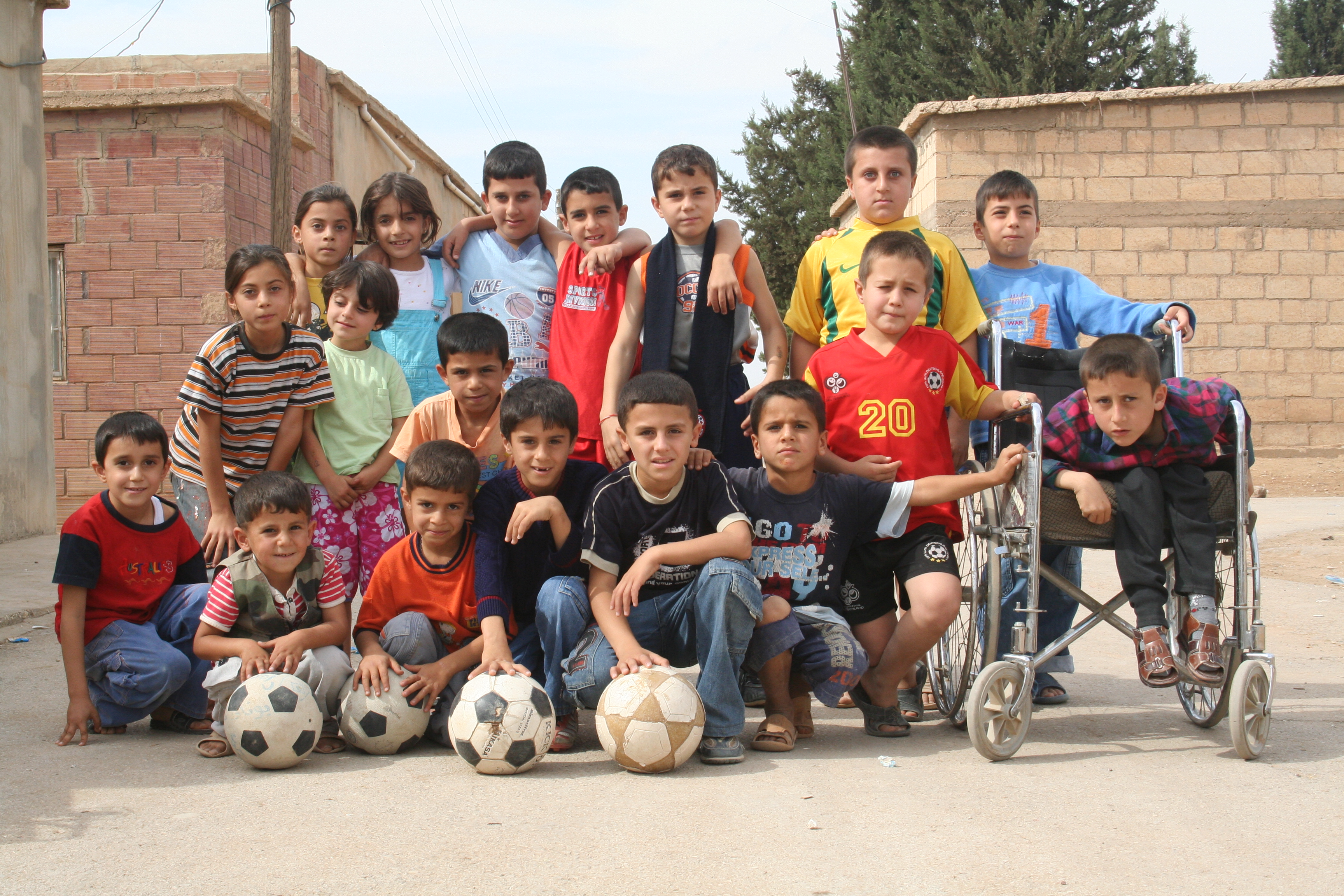
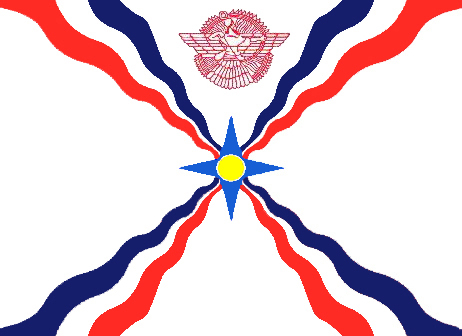
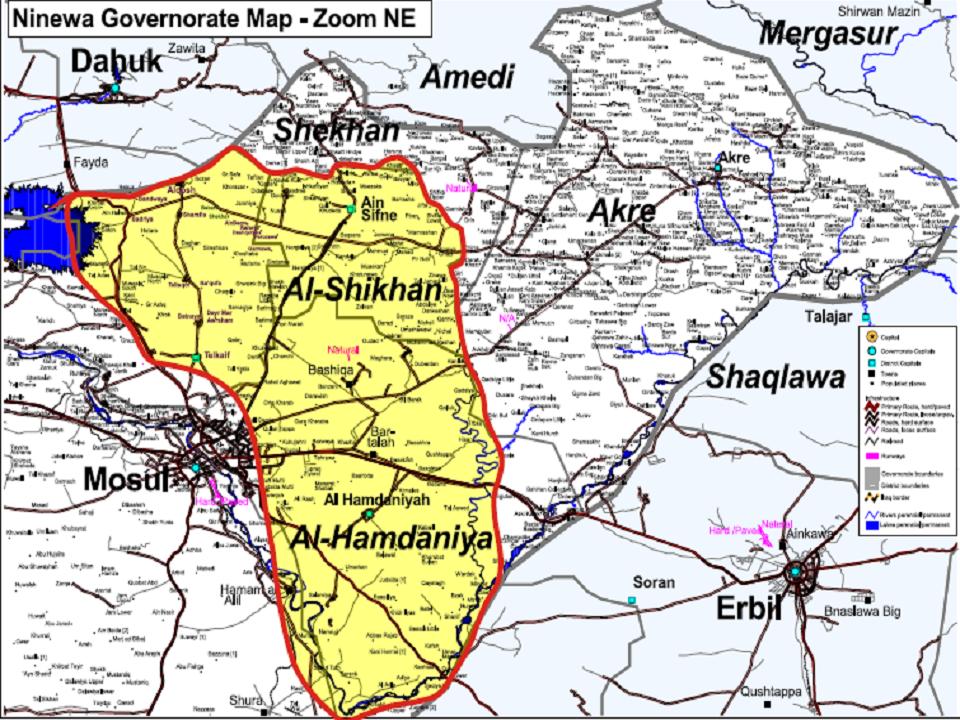
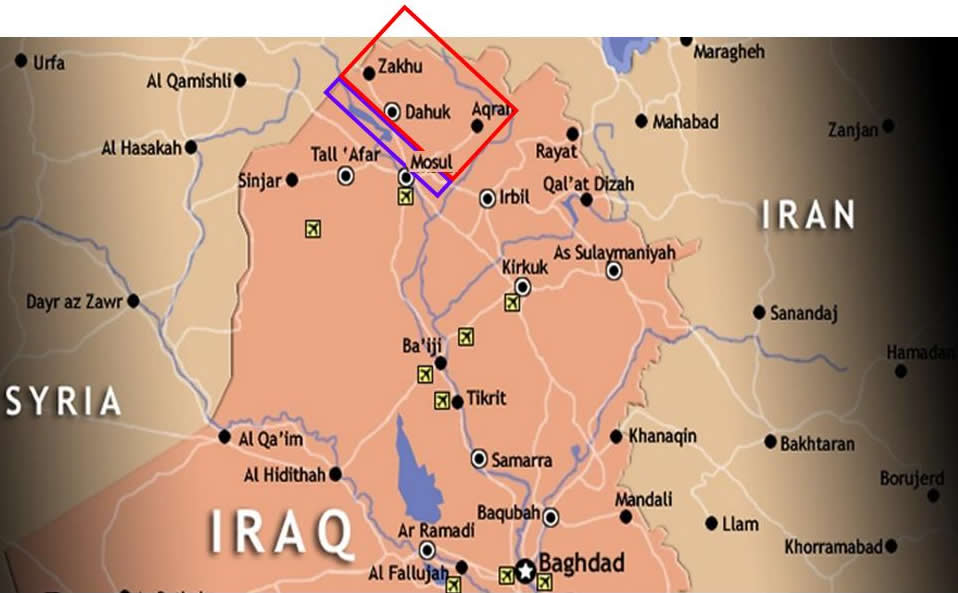
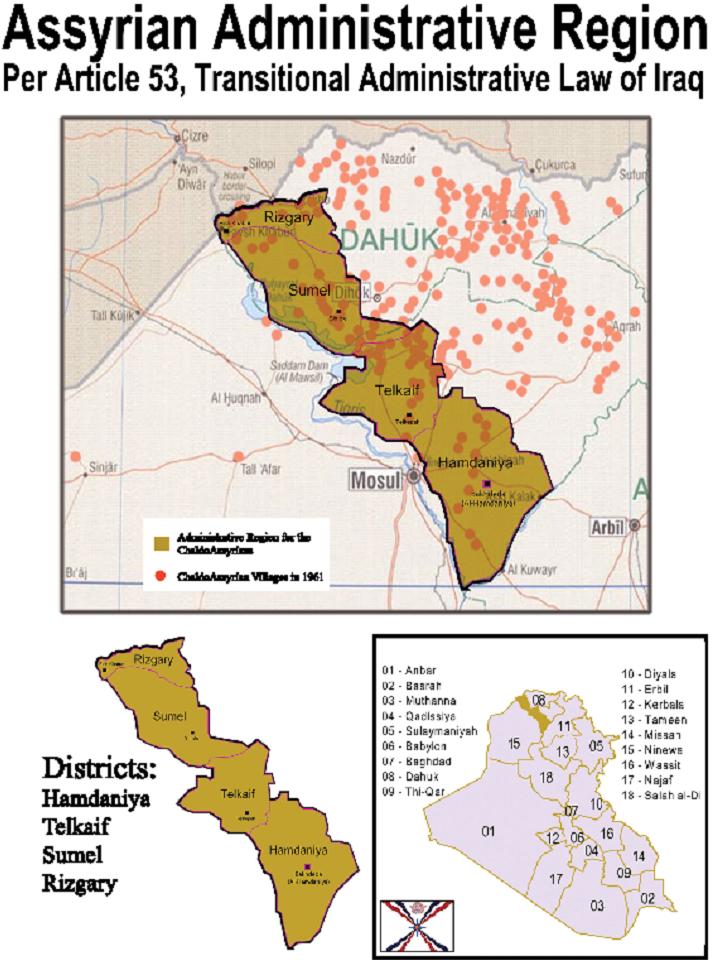
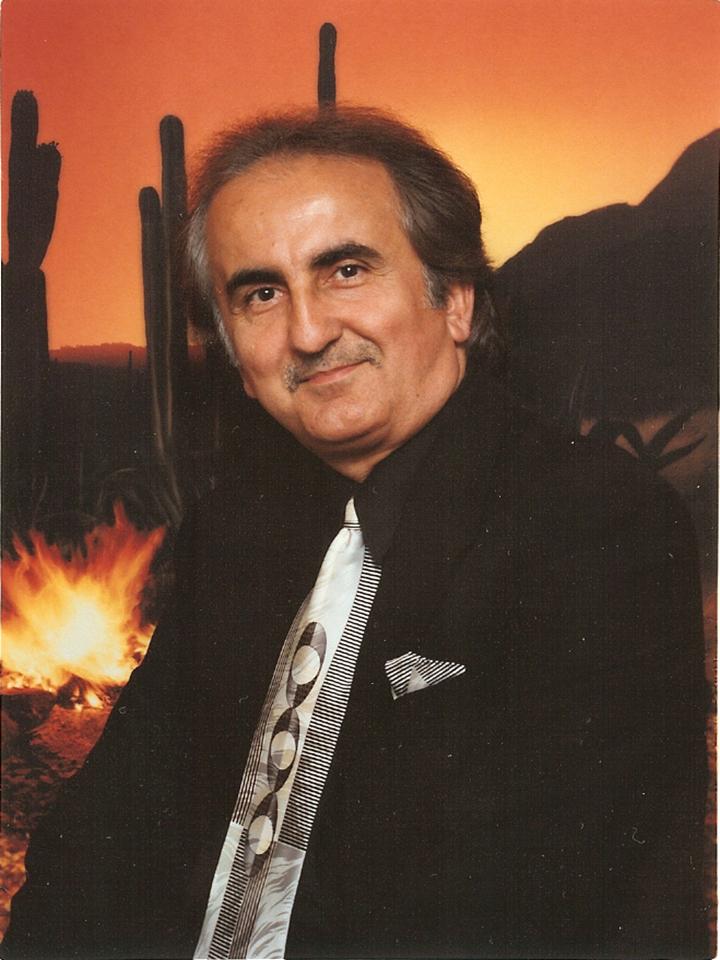
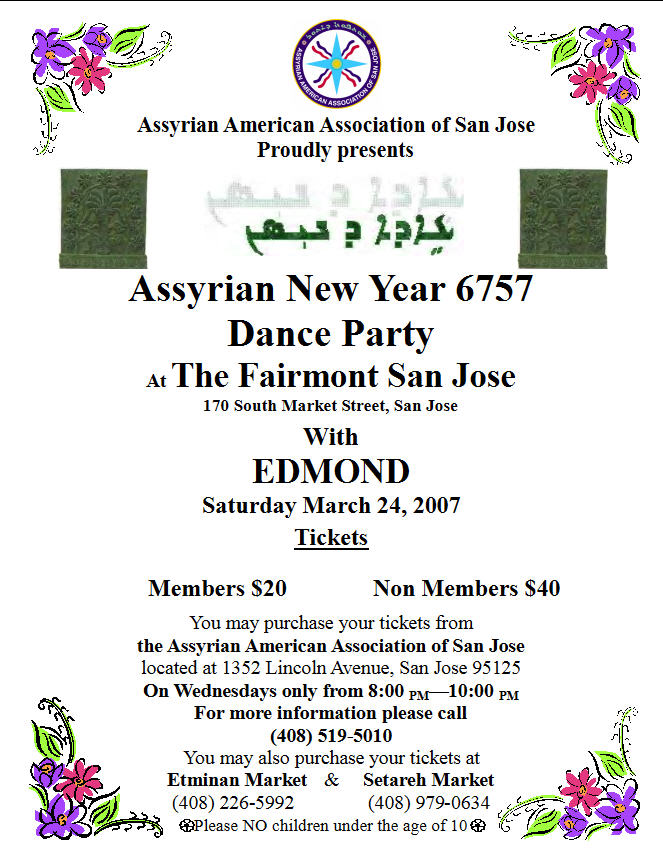
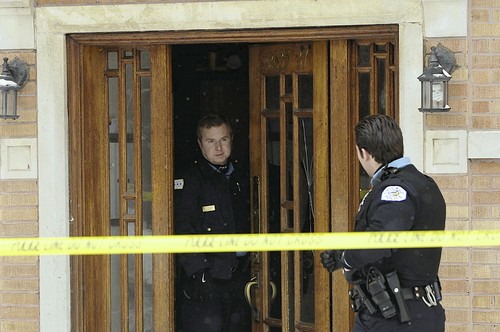
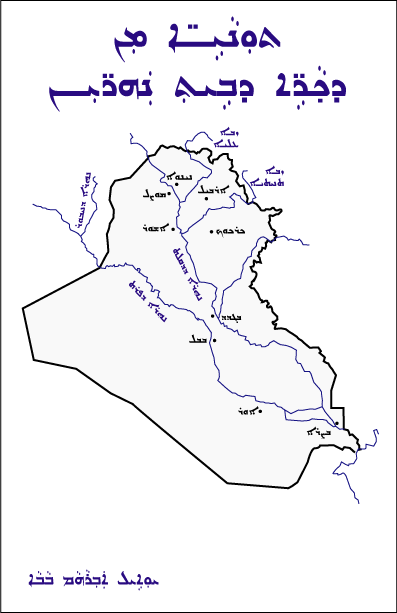
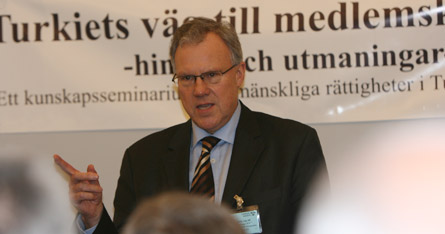



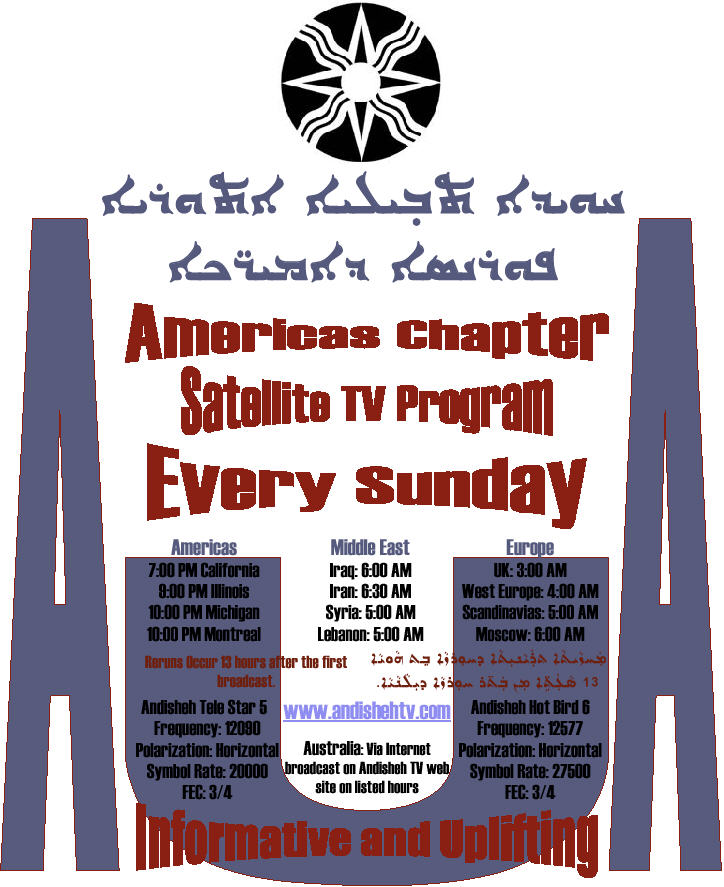

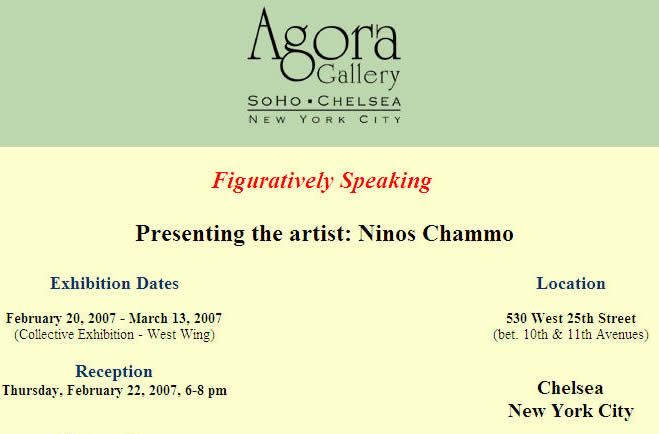
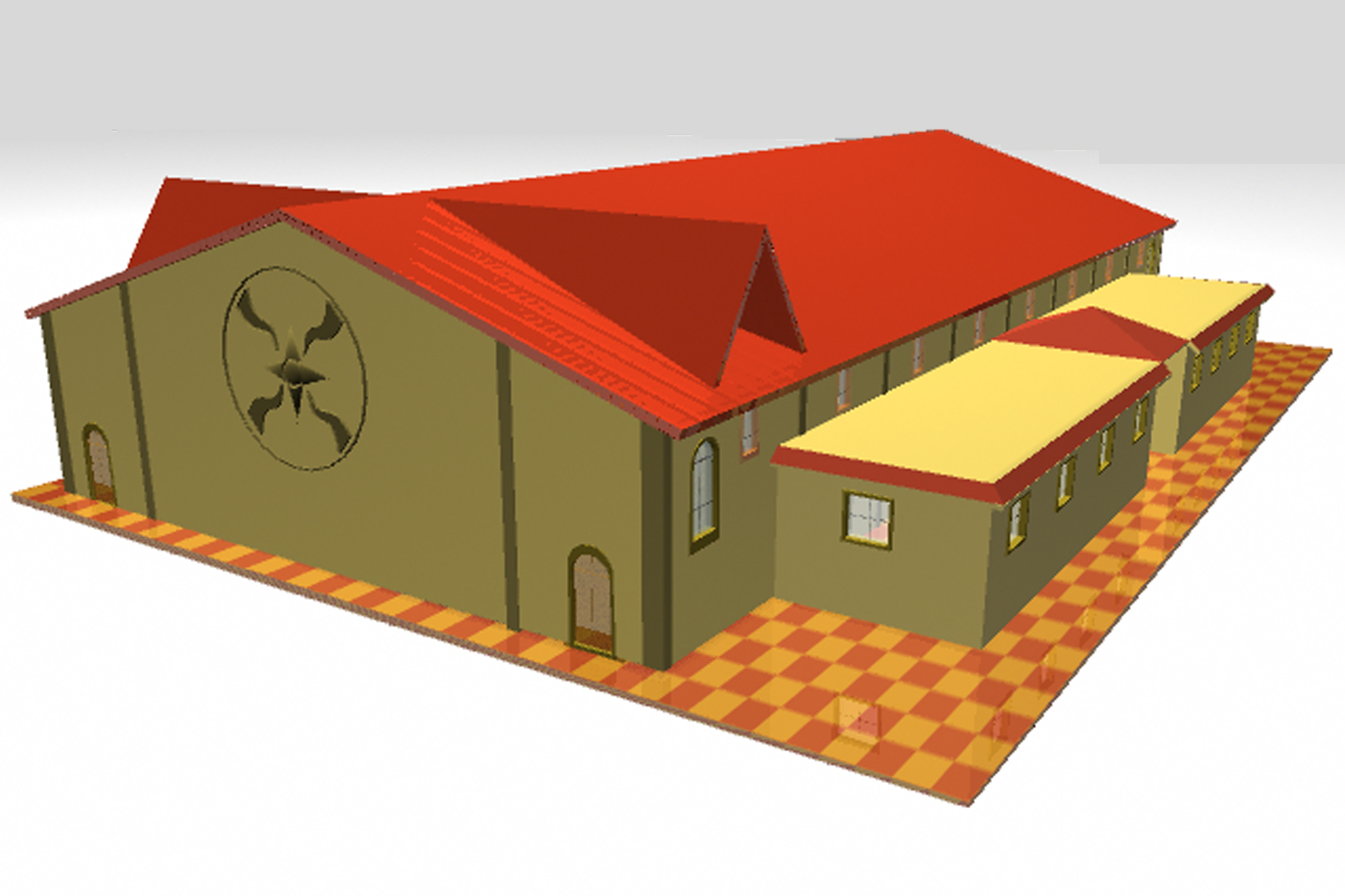
 To learn more about William Daniel see the second article in this week's ZINDA SAYS section and Dr. Arianne Ishaya's "In Praise of William Daniel" -